Harold Abramowitz

A Whole Host of Events

23.
     The day was going to be beautiful.
     I put my hands out, looked at the sky.
     It was funny.
     A whole host of events.
     And even after all of that time.
     You wanted to lift your eyes up and stare the day in the face. You walked out the door feeling well, looking well. It was going to be a beautiful day.
     It is very weird to be alone, I thought.
     A kind of stranger walked into the room. A whole world in tears. And there had been a discussion of exactly that on the radio earlier in the day. And there were no distractions and there was no running about the room looking at things. A little after the morning. No, the daybreak. You have run out of the very thing that I came here looking for? You were surprised. You were under the impression that things were fine. Then you stole something and tried to find out how much it was worth. You went back to the store and asked the clerk a question. You thought there were very good reasons for feeling angry, at that point.
     The afternoon ended up being very warm. I had a lot of things to think about, at that point. It was going to be a very beautiful day.
     In the morning there was a horse drawn carriage and a warm furnace. Folding out paper and taking a little walk. You are talking a lot, and then you have to go, I thought.
     Why do you ask? You were asking a question. The ground where the snow was resting. It was high in the hills. There was no more asking. You are asking. I am running. I am running in and out of the house and looking around for something good to eat. I am asking directions on the street because I have no friends, and I don’t have any spare change to give to anyone either. I wanted to do things. I wanted to have some good luck. But when it is time to get out of here, you will know, I said.
     You were gallivanting around the house. You took your time. You washed your hands. You loved the way you looked, at that point. You sat in the living room and waited a minute. There was a tub with cast iron feet in the room, and you were about to ask what to do with the tub, how to fill it with water, and why it was there, but you stopped yourself short.
     There was a rabbit on the trail. All the children had seen the rabbit. And eating that much food at one sitting is just asking for trouble, I said. The radio was playing very loudly in the next room. I’d had it. I was playing the piano and wondering why I had ended up living such a dreary life. Why I was so lonely. I longed for something extra to put in my pocket, so to speak. I held my hands out. I wanted to buy something new. It was going to be a beautiful day. And it’s always so cold in here, I thought.
     But the thought of products. Of being beholden to someone else. The moment one has to have that one special thing.
     And I am the product of being born in a weightless room. And who am I to tell you what you should do with your hands, what you should do with your friends?
     It piles up. There are scores of colors. There is nothing left to do at work. But I have to sneak out of this room. I have to sneak out and hit the streets and look for many special things. Colors and other things too.
     Have you ever seen a better position? The clouds in the sky. And everything is so perfect, I thought. I have not wanted to be anywhere else for a very long time. But the time goes by extremely fast anyway. I guess that’s what it means to be satisfied. A whole world of satisfaction. Of people being put together. And if I were the best in the world, I thought. If I were the person I wanted to be, and this hurts me very badly to think about. I had all kinds of fantasies, at first. I had very many things going on. It was really bothersome to think about.
     It was going to be a beautiful day.
     Sunday was your favorite day of the week. You held something in your hands, and no one was particularly good at what they did anymore. No one could ever be counted on to do a good job.
But no one was starving then either. It was audacious and interesting. On top of the wall. The way I stare. The things I can see in your eyes. And it is real love, too, or so I thought at that moment.
     There is something special about you, I said. The nighttime. This is my least favorite time. I have to go. It was going to be a very beautiful day. I will go home and work very hard and do a lot, I thought.
     You sat at your desk and stared out the window. There was something moving in the bush in the garden.
     I put my hands out. I told lies all the time. There was a nest in a tree in the garden. I looked at the tree very carefully, I said.
But you are always looking down on people, you said. The field was full of blooming plants. The field was beautiful to look at in the wind. It was going to be a beautiful day.
     It had taken you a long time to feel the way you were feeling. And it was absolutely essential to feel that way once in a while, too, you thought.
     Even I’d said the same thing, and that had been on a Saturday.

24.
     There was the fix. Or the fix was in. At least that’s what you said, or how it was put. There was a tree and a dog and a fire hydrant. And then the summer came. You were sitting up straight, under no illusions at all.
     But you never call me, I said. The summer had been uncharacteristically warm. I was at home. I was talking on the phone.
And people are funny.
     I lived in a house.
     There was a purse on the floor, and a bag, and a saddle.
     You are after the first thing you see all the time. I find it terrifying, I said.
     Somebody so personable, you were trying to see your way through. It was a strange moment and there were a lot of reasons to be afraid.
     I am going to your house after school. What I was waiting for, I never found.
     It was the summer. You lived in a house. You put your foot in the door. There was a real question of the way things were going to be.
I sit in this chair every single day, I said.
     I can’t believe the things that are happening to me. It happened in a boat at first, and then on the shore. In luxury buses. There were good things that were going to happen, getting ready to happen. I was so happy. I couldn’t believe how happy I was.
     The thorn. I was wearing the thorn and then wondering why I was there. Why was I there? What was I doing in that spot? A figure. The way things are done around here. And there is trouble. I think there is trouble when I’m around.
     A morning. You were sitting in the morning sun. You put your hat on. A table. And vegetables. And coffee too. Sitting in the morning and wondering what to do with the rest of the day. It took a long time to decide. The function of the day. The way the day was going to go. And you felt jumpy and irritated. You were moving all around. Not a word from your friends, though. No relief. And everything cost so much money. And the horror of looking at a life without reality. Without the tides. The terror of the tides. The loud mouth. The making of a million dollars. And then there was one and then there was another one. And then you were told, instructed, in a way, to tell lies.
     I am afraid of the things I see, I said, at one point. I am afraid of the things I am beginning to see. The things that are beginning to come around. And the proof is in the pudding. And this is the answer to the various questions. You see, I was seeking answers in those days. I was seeking answers and asking for the truth and telling lies. I never told any lies, but lies seem glamorous to me today. And why do I think anyone would be paying attention? I asked.
     Why, it would make anyone feel guilty. The expense. The razors and the pins. All the sharp things that were lying around the house. The things that moved silently at night. No bump, you know. Then you smiled. You were wearing a blazer and a cap. A sweater and shoes. You were like a famous dancer, and the way you lifted yourself up and moved around was very special.
     There are special things in this house. There are special things that are surrounding us at all times, I said.
     I should come here more often, I thought to myself. I should put my house in order. I should take my shoes off when I get in the door. I am standing in the doorway, and I am asking myself some really stupid questions. I have a voice in my head, and I wonder how I am going to get any work done that day.
     I am wearing a suit and I have a certain expectation about the way things should be. I put my hands in my pocket and settle in for the night. I was walking out in the rain and telling myself that things were going to be good, that things were really starting to improve.
     There was an argument in the house. Outside the house. There was an argument in front of the house, on the sidewalk.
     Of all things, coming home in the middle of the night and finding out that there was good news. Good things really were happening. I was excited. A whole world was opening up for me, at that point.
     I could have told you that that was going to be the way it was. I could have told you. I should have told you that I was going to be coming home late. But I really wanted to apologize first, before I said anything else.
     And it’s like a dream, you know.
     The way things are. A bed of flowers. A hope chest. A really pretty flower garden. And, at times, it was clear that everything was going to be okay. If you put your mind to it. If you were going to amount to anything, or rather, if your day was going to amount to anything.
And then it happened. No, it happened. It was really happening. Like music. You thought so. You thought so and then it happened. It all happened fast. It all happened in a flurry. A rush of events. Unbelievable events. You thought of the way things were. You thought about the way things were all the time. It was no lie. There was no lying involved. Forcing your hand. Asking for help.
     It was another day. I was supposed to have gone to work. I was asking for help. The best thing I could have said under the circumstances. And in my eyes. There were good things happening in my eyes, or so I believed, at that point. A little complaint. A little bit of a bad omen, I thought, and then there was too much time. But it wasn’t clear if an apology was in order or not. I wasn’t sure about whether or not I’d already apologized.
     And they look at you. With eyes. Or that’s what you were thinking, at that point.

Nominally about story and perception, at its heart, Harold Abramowitz’s writing is epistemological. It asks that attention be given to the mode of telling. He is the author of books and chapbooks, including Blind Spot and Dear Dearly Departed. Harold co-edits the short-form literary press eohippus labs and teaches in the Department of General Studies at Charles R. Drew University in Los Angeles.

Dayna A. Gross


Sade

In my past, death has already un-breathed. What once was and is are no longer the thoughts I was born with. Language has brought me back to the point and then away from it again, like an ancient symbol. This is why I photograph and will never be a writer. Writers know how to reveal their contradictions. I want to understand my behavior, why I resist and why I give in. I trust my body is hiding invaluable truths. The sharp pain of these whiskey notes stirs my spirits.

One day I’ll dedicate myself to all types of breathing, just like I’ll commit my existence to the language extreme and unwrapping – no – tearing apart of veneers. What moment is worth capturing? What must I preserve in the fixer, reproduce in the dark room under the unveiling of light? I’m holding onto several answers and they are leaking between my fisted fingers, slowly breathing outward.

    I hold many frames in my mind. I want to capture the instant, but once it’s caught it is in the past, and their unobtainable forms tortures my philosophies to satisfaction. I must prepare my camera equipment and photograph a dancer. Yes, a dancer. I stand up and position myself in front of the bar. I rock my hips from side to side on the barstool. And roll a cigarette. That was when Sade approached me.

Sade undresses and dresses again in front of me, “After I left you the other night, I took the s-bahn home and a man followed me from the station to my apartment. He rolled a joint and we got high. I ended up in a taxi with him. This morning I found a recording of our whole conversation from inside of his apartment, including the part where we had sex and I fell asleep, you want to hear it?” Sade asked.

We both listen to her moaning, but it mostly sounds like a lot of shuffling. I hear his low voice, but can’t make out any words, or country of origin.

“Apparently he had a stutter and tried to wake me up. He told me we had to go, he needed to meet his brothers in the park. We got into a cab and I ended up in my bed alone. I think it was five in the morning. Could you hear that he had a stutter?” Sade asks. “I don’t know his name, I don’t even remember his face, but he might recognize mine. Oh well. He won’t be the first and he certainly won’t be the last,” Sade says while strategically pulling down a red velvet box from a top shelf, her large lopsided breasts spilling over her corset. I look down at the way her heals lift her body upward.

    “Do you mind if I use your recording for something?” I ask. “There are these moments in the world that people know they can be living, but cook dinner and fall asleep to a movie instead. Let them live through your story. Are you ready for your portrait?”

    When I met Sade in the bar, she was accompanied by three men of three different ethnicities eager to capture her gaze. She was intrigued by my intensity and approached my concentration. I was fascinated by her ease and her indifference to her audience. Eventually she asked if I’d like to join her for a threesome, that she’d like to get to know me a little more intimately. I asked her if she would like to meet again for a photoshoot.

    “Can you sit on the edge of the bed? Bring your right foot completely out towards me and bend your left leg a little, spread them a part a bit more. I’m going to put the flame on the ground between your legs, just get as low as you can before it gets too hot.”
    “Oh, but I like it hot, you must know that by now,” Sade says.
    “Okay, then I’ll use the longer red candle I originally had in mind. Now lean back on your forearms and seduce me.”
    “Do you want to photograph me tying up my boots first? I can put one leg high up on the desk. These boots are stunning, I absolutely have to wear them for such an occasion!”
    “Yeah, it’s better if you put your leg up on the chair, but let me set up the candle holder first and light the candles.”
    “I like the color arrangement of the candles, that’s a nice touch,” Sade says.
    “Yeah, each color corresponds to a planet and the days of the week.”
    “Oh, I like that very much.”

    I photograph the woman, amazed at how beautiful her body is, so full. The way she carries herself makes her size flow flawless as if this shape has been sold and desired by women all over the world for centuries.

“Thetis dear? Can I ask you something personal?”
“Always.”
“What is your relationship to your body? Do you feel free in your body? Disconnected from her powers? Or, do you feel confined by her shape?”
“All three I suppose. Depending on my environment and where I’m at emotionally and intellectually.”
“I can see that. I believe you would benefit from unconventional sexual experiences. We live in a very confusing world, where money and sex have no clear boundaries. It’s up to us to explore and define these lines for ourselves, you know what I mean dear?”

Sade’s proportions on anyone else would seem disorderly, but she allows her uneven breasts to hang freely over her leather corset, her thighs much larger than her calves, her upper arms hang loosely from behind, and her eyes, her skin, glow like Icelandic ice caps. Those eyes will never mask her intentions; a youth she will nurture, undulating through time like the ocean tide.

“Desire is confusing. I’ve always wanted to be desired, but in a private way. In a way that doesn’t demand attention. I grew up in a religious home. For the first 18 years of my life I thought I wouldn’t have sex until I was married. Then I decided to destroy as many confining regulations as I could find. But I destroyed it delicately. Gently tugging at the roots, to leave behind as few threads as possible. I don’t think I’m a person who gets off on destruction. I get off on freedom, but in my case, all acts of freedom are destructive. The conflict is forever present.”

“Sweetheart, I’ve been there. I know the feeling. But our bodies our powerhouses of pleasure. And our societies are brimming with executioners and priests of shame. Your body will be a site of shame until you let her play in the wilderness. There’s an abundance of opposition in our world. We can’t let them tell us what to do with our bodies. Learn to balance out the mind with the body, instead of living in this world of logic where we fall into the prison of the mind. Trust your body.”

I concentrate on moving around the room like a centipede and photograph her from various perspectives. A silence cascades over the candlelit room. The only audible sound is her soft breathing and the clicking of my camera. Her gaze makes me feel as if I am the object and she is the predator.

My family would be repulsed by such hedonistic ideas. For them, this way of thinking cripples morality. They don’t want to understand how much they confine and restrict the body, especially the female body. Why do they fear sexuality? and beauty? Common-faced sister is already worried about her own daughter, she says it’s going to be terribly challenging at some point because she can see that she is remarkably beautiful. She’s afraid of the way people look at her. Her daughter is too young to notice it now, but common-faced sister is afraid of how the realization of her beauty can affect her spirituality, like a hand of darkness reaching for her soul.

I press the camera forcefully against my cheek and squeeze my exposed eye tightly, though I truly want to see her through every sense I posses. We move through different postures and positions. I photograph her seduction from all angles until I am no longer ashamed of looking, and move beyond admiration.

I want to capture her world, her private world. The world men and lovers don’t have access to. After clicking and rewinding three rolls of film, I feel exhausted. I’m too acutely vacuumed into this woman’s mind. I’m losing my sense of boundaries. I pack my equipment and hurry off to the supermarket. Uneasily, I search for Spanish oranges.

Dayna A. Gross has been published and shortlisted in the Büro BDP Writing Prize 2020 (November 2020), Angel City Review (July 2020), Another Chicago Magazine (June 2020), RHNK (2017), JFKI (2018), Seeing Her Ghost (2017) among other small press publications. She lives in Berlin, Germany where she hosts an experimental poetry radio show called CRYPTOMNESIA, which streams FM in Berlin and Brandenburg.

Olga Vereli

KATHY ACKER ON THE BUS

the horizon is dripping honey and cement
industrial lights of Eleusis

“there will always be somebody riding the bus”

Don Quixote is heading to a party uninvited,
today’s tarot reading told her it’s time to socialize again

She’s thinking of performing a ritual on a crossroad
in the mystical place that is Eleusina,
a landscape oozing with primordial power
coming out of earth’s vagina

the vagina is always industrialized
The first industrial revolution happened when
the first sex workers started working on ancient dicks.

She’s ready to call upon the power of
GAIA and HECATEHUGE SLUTS
tomorrow noon. Everything is calculated.

The ritual will include Kathy using a rosemary branch
dipped in water and oil to spill it over her naked body.
Then she will go eat boiled bitter greens in a nearby tavern.

The vampire men of Eleusina will be watching her
but she knows their game
She knows the incestuous crimes they’ve committed
Their sperm transmits nationalism
She’s here to stake Lord Byron, their patron saint and father
Drive her wooden stake right through his heart
She means business this time

      Justice and Piety august I call,
      θραύουσα δικαίως,
      human life annoy

those mothers who are fathers
I’m always that person who notices how violent their love is
they want your love to be used as a weapon, just as theirs

είχα ήδη αρχίσει να διαλύομαι στον αέρα
ήταν ξένη σ’εμένα όμως χρησιμοποιούσε
το σώμα μου ξεκίνησα να μιλάω
για να σταματήσω την ευγενική εξαΰλωση

street signs fading into languorous music           ως πράκτορας ενός παρακράτους
“how to invent a language                                   μυθοπλασίας
on a bus”                                                             προβοκάτσια:
some passengers are asleep                               προκλητική συμπεριφορά, λεκτική
others murmur softly                                            ή/και γραπτή με σκοπό
prayers to St. George                                           να υπονομεύσει τις παγιωμένες
                                                                                                                          σχέσεις
the slayer of dragons                                            συγγένειας

when stretch’d upon the bed of grief
the sex seeks relief
συρματοπλεγμένη πολυάνθεμε
πολυώνυμε δαίμων
ποια ώρα διαστέλλεται
ποια δαίμονας θα φέρει επάρκεια σαν πορτοκάλι
ποια επανάληψη συλλαβών

(tombs of ancient tribes are resting beneath the houses
in the woods there’s mostly pines and ruins of dream hotels
capitalism is falling apart and re-emerging as a vampire tooth
we’re looking at Kathy’s short hair, her tanned skin, a bloody knee)

She’s tried foolishness, loneliness, sexiness, emptiness
licked the sorrow from the wound

Here to plunge once more in the womb waters
PROTHYRÆA
venerable pow’r, who bring’st relief in labour’s dreadful hour
λύσε τους πόνους μιας αρχαίας αλφαβήτου ντροπής

the whole world is an orange
I’m inside a worm bus traveling across this juicy sphere that is non-stop producing sticky dreams
endless solar power
eternal desire
my body is your body and your body is one with the orange sun and I will never die

Olga Vereli is a writer based in Athens. Her work is interdisciplinary and cross-genre. She has published a collaborative zine under the title The Cemetery Is A Forest and runs the newsletter The Gizi Resident.

Chiara Crisafulli

O

day 7

That summer night,
a year after Aris left, like
a brave sober drunkard
I dared ask why. Why did
you disappear? Why did you
leave all of a sudden?
 
                    (I left because I’m young, he said,
                    ten years younger than you.
                    What do you want from me?)

Our first night replayed in my head.
‘Do you feel safe?’ he said, staring at my tears.

So many unanswered questions
and ringing Sunday mornings.

All the shooting stars draw
a path heading for the
green –

I look at my feet.
I think maybe I should have worn
a different pair of shoes.

day 14

Today, after
a run and wrinkled
cravings for Kalamata
olives, I left
the peels of my avocados
and phantasies over a trip to Spain
leaking in a big
black, garbage
bag.

Barefoot
still
wearing
my violet
white H&M running shorts
going
down the stairs. The

touch of my
                 skin on the steps. The taste of
                       my bones on the shiny wooden
                               floor. Beyond the heavy

building door, wind
grabbed my body. Kicked it,
made it scream.

Then
I saw Aris. Unexpected,
ghostly, unreal.

Eyes warm and frozen.

He was sitting next to the gate.
He was texting with his phone.
He lifted his chin and smiled

but I had to let go
of the garbage.
I had to
close the door.

day 28

These days I sleep
less, dumb thoughts
ovulate: heated,
salty eggs for
breakfast, fine leather
biker boots. Cooler,
nail polish
remover.
Bulky breasts as
village
church bells,
loose black locks

shutter my

thirsty,                                                                                                                                               stinging,

darker nipples — like shepherds on plateaus
                    tending to their goats too early at
                        sunset. When I digest my

period cramps,

breath crumbs

like truths

I knead with my bare hands to
strawberry cheesecake. This is how I
                                                                surrender to my body:
to its language so far unknown. There’s no
migration of cells but
rather, in-house
talkers — like hens. They gather close to my cheek,
sometimes it’s my hip or my
left ankle, and lift a

red, thick curtain to
show me a toddler in a
stroller. He squeaks,
laughs and when sucks his
big toe I see he has no
teeth.
                                                      Then I read. A gig. Around you.

Your voice// your lips// move fast /

then slower / and slower /          and          /                    slower       /
                                                                                                                            warming / juicy flow/
saliva / us / moaning /
                                                                                                              brushing kissing/
                                                        …what was I doing…again?

Your stomping chest is no distance I can bear. Ache

pours into
empty
wombs, weeps
dyed words       now


drying —
over the shell of this
full moon

Chiara Crisafulli juggles words, space and un-structures with no desire to restrict forms and/or genres. Her dream is to see ordinary things turning into art—plastic garbage bags, scratches of paint, glimpses of light. Before being a body of work, art is a way of observing (ourselves in) the world. Originally from Sicily (Italy), Chiara wrote her first poem at age 7 inspired by the moon, boredom and loneliness.Her academic background is in journalism, philosophy, teaching English as a second language, playwriting, travel writing and contemporary poetry writing. In the past eleven years, she has experienced living, travelling and volunteering in different countries including Ireland, Holland, Greece, the Canary Islands (Spain) and Portugal. She currently resides in Lisbon working as an interpreter and at her first experimental hybrid poetry book in English.

Γκέλυ Γρυντάκη

ενaς pολemος

Living like bats, or owls
labouring like beasts, οι μάργκαρετ c.
dying like worms

οι μάργκαρετ c. πονάει
• από τα χτυπήματα της συγκατάβασης,
• της ευγενικής απόρριψης,
• τα ωωωωωω και τα αααααα του ευσυγκίνητου κοινού
• τον κρυμμένο σαρκασμό στις υποκλίσεις, κάτω από χοντρά σβέρκα που τραντάζονται από γέλια και lust
• τα τοξικά σάλια στα χειροφιλήματα

η πατριαρχία είναι ευγενής για να είναι πιο επώδυνη, έχει περιποιημένα μυτερά νύχια που γρατζουνάνε στην χειραψία και το οξύ τους καίει για πολύ ώρα μετά

και ε σύ ψάχνεις (μικρά) αναλγητικά αλλά αυτά δεν φτάνουν πια
now the drugs don’t work emily

στο τρανς σου μπαινοβγαίνεις σε αυτό που θέλεις να είσαι σαν εκείνα τα εκκρεμή με τις μπάλες που συγκρούονται πέρα δώθε                                          πέρα
δώθε                                                                                           πέρα
δώθε                                                                                  πέρα
δώθε
αυτή    η    ψευδής    εντύπωση        αι        ω         νιότη         ταc
(φίλε είμαι επιστήμονας.                                                         ξέρω καλύτερα από τον οποιοδήποτε           τι                   σημαίνει                             κενό
καιτιτριβή

έχω αλλάξει 999 πουκάμισα από κερατίνη κι ε ξ α ϋ λ ώ ν ο μ αι λίγο περισσότερο κάθε φορά που
θυμώνω;                 σημαίνει                                 και μετά

η κούραση είναι
αβάσταχτη
για να ξαναμαζέψω
την ύπαρξή μου
και είμαι
πάντα
ένα τσικ
πιο
λίγη)

οι μάργκαρετ c. αγαπάει το μυαλό της       μισεί το μυαλό της
αγαπάει το μυαλό της       μισεί το μυαλό της

αλλά αυτό το τικ τακ είναι εξαντλητικό

θέλει να το βγάλει για λίγο,
να το αφήσει
σε ένα ποτήρι φορμόλη στο κομοδίνο
σαν μασέλα
ή δείγμα σε cabinet de κuriosites

θέλει επιτέλους ν α α ν α σ ά ν ε ι
να νιώσει κρύο αέρα να χαϊδεύει το εσωτερικό του κρανίου της
που καίει
θέλει να νιώσει πώς είναι
να μη σκέφτεσαι τίποτα

ίσως αν καταλάβαινε λιγότερα να σταματούσε (you have the right to remain silent?)
και αυτό να ήταν λιγότερο δαπανηρό για το εγώ της

το αναγνωρίζει

δεν μπορεί όμως να κάνει κάτι γι’αυτό

το εγώ της της αναλώνεται οδυνηρά κι αμετάκλητα
γλιστράει από τις σελίδες τα σημειωματάρια τα folios τα γράμματα τα notes
ξεχύνεται με κάθε λέξη από μελάνι στο χώμα,
το χώμα και το εγώ της είναι ένα βλασταίνουν μικρά μωβ φυλλαράκια βολβοί ρίζες φυτρώνουν μεγάλα σαρκώδη μανιτάρια σαν αντρικά δάχτυλα
που δεν ξέρεις αν είναι δηλητηριώδη
αν δεν τα δοκιμάσεις

α σ κ ή σ ει ς τ α π ει ν ό τ η τ α ς
α σ κ ή σ ει ς εί ναι
βαθειές ανάσες

ίσως αν καταλάβαινε λιγότερα να μην έφτιαχνε ελπίδες από σκόρπια μανιφέστα

η ελπίδα είναι πιο κοφτερή από τα νύχια τους αλλά οι λεπίδες της είναι διπλές
όσο βυθίζονται σε σένα βυθίζονται και σε εκείνους αλλά αυτός ο πόλεμος είναι άνισος,
γιατί η από κει μεριά είναι χοντρόπετση είναι από πλαστικό ή λαμαρίνα
είναι μονωμένη από διογκωμένη και εξηλασμένη πολυστερίνη από αφρό πολυουρεθάνης και χιλιετίες, από πετροβάμβακα, και τόνους αυθεντίας
τόμους αυθεντίας
δεν νιώθει

«ένα ακόμα μικρό τσίμπημα για την πατριαρχία μια βαθεία μαχαιριά για τις μάργκαρετ c.»

οι μάργκαρετ c. όταν πονάει θέλει να κουκουλωθεί να τριγυρνάει με ένα μεγάλο μακρύ γυαλιστερό μπουφάν υαλοβάμβακα που σέρνεται στο έδαφος στους κήπους του Kensington, να καλλιεργεί σαρκοφάγες ορχιδέες και daffodils στα μαλλιά της
να σκαλίζει απαλά τη γη με μια χτένα

να ψιθυρίζει λυπημένα χαϊκού στα
σκαθάρια και τις αράχνες να μιλάει στους
κοκκινολαίμηδες και στις ξανθές αλεπούδες

(που φαίνονται συζητήσιμες και ανοιχτές στο ευγενή διάλογο και την καθαρή επιχειρηματολογία)

οι μάργκαρετ c. όταν πονάει θέλει να πέφτει από παράθυρα να καταπίνει δηλητηριώδη μανιτάρια να αυτο-πυροβολείται στην καρδιά να βάζει το κεφάλι στο φούρνο να γεμίζει τις τσέπες με πέτρες και να βουτάει στο ποτάμι

να κλείνεται στο γκαράζ να
βάζει δυνατά τη μουσική και να ανάβει
τη μηχανή του Cougar της

dont they know its the end of the world cause you dont love me anymore

οι μάργκαρετ c. όταν πονάει είναι το yellow stone το κοζλοντούι και η φουκοσίμα
       είμαι ο βεζούβιος το κρακατόα και το Eyjafjallajokull είναι δύσκολη
          στην ανάγνωση και στην προφορά είμαι καυτή και παγωμένη
              ανορθόγραφη και επικίνδυνη είναι έτοιμη να εκραγεί
                 να καλύψει τον κόσμο με δάκρυα λάβα
                        και να εξαφανίσει τους
                            δεινόσαυrους και
                                άλλα δεινά

οι μάργκαρετ c. όταν πονάει θέλει να γράφει αλλά όταν γράφει πονάει περισσότερο

Gelly Gryntaki is a curator and a writer. She writes about art and other things. She has organized and curated a variety of art projects and exhibitions in Greece and abroad and several of her texts have been published in printed and online media. Her website is https://www.art-cat.gr/

IN THE ABSENCE OF DEMOCRACY

A Rebuke to Government or a Protest Text With No Signature

We belong to the majority, which you do not serve as prescribed by the Constitution.

We belong to the 60.15% who didn’t vote for you.

We are 18 and 27 and 40 and 54 and 65 and 82 years old, people of every social gender who have the right to quality public education and health care, who refuse to work 10 hours a day or live in conditions of precarious labour and stay for years on the lists of the OAED (Manpower Employment Organization), who support egalitarianism and the promotion of equal opportunities as well as the care for vulnerable groups of the population and the protection of the natural environment, which is not destined to burn at some point, as you have the nerve to claim.

Your duty is to take care of the common things, public land, public health care, public education, contemporary culture, the vulnerable groups of the population, the quality of living of all of us. But you are indifferent to your duties. In an unprecedented disdain of the common good, you stand as the junta’s continuers and defend obsolete policies towards critical problems concerning climate change and the planet’s future.

You frequently vote on your authoritarian bills and provisions by way of urgency procedure at the last minute. This way you exclude any discussion and take the social body by surprise, before it has time to react. The mornings find us with even fewer rights. You have not the slightest intention to look after the social body. It stands in the way of policies you promote in an artificially hostile climate.

You’re strengthening the private sector like you’re strengthening hate.
You’re fabricating enemies like you’re fabricating the news.
You’re abusing human life like you’re abusing the natural environment.

You’re using the House of Parliament as your corporate headquarters.
You’re confusing the country with the private fiefdom.

When you undermine the fundamental rights of citizens, migrants and refugees, you undermine democracy. We are the social body upon which you commit frantically and shameless crimes, in order to enforce your antisocial governance measures.

YOU TOOK US BACK.

You took us back when you promoted the police state with the “law and order” doctrine.
You took us back when you reinforced the police with 31.5 million euros.
You took us back when you formed the Campus Protection Team.
You took us back when you attempted to control and censure the freedom of artistic expression.
You took us back when you abolished the General Secretariat for Gender Equality.
You took us back when you introduced compulsory joint legal custody of minor children.
You took us back when you funded the mass media to serve your communication policies.
You took us back when you devised the National Plan for Managing Public Outdoor Gatherings.
You took us back when you introduced the Glamping label to companies that carry out projects in Natura protected areas.
You took us back when you replaced the eight-hour workday by 10-hour workdays.

We’re watching you. We are the foreign body in your authoritarianism. We are disobedience itself. We are your democratic nightmare.

Your government is anachronistic, authoritarian, divisive.
Your government is abusive, misogynistic, offensive.
Your government is antisocial and unconstitutional.

You have replaced the already suffering democracy with tyranny.

We ask for your resignation.

ΟΤΑΝ Η ΔΗΜΟΚΡΑΤΙΑ ΔΕΝ ΕΙΝΑΙ ΕΔΩ

Μομφή Κατά της Κυβέρνησης ή Ένα Κείμενο Διαμαρτυρίας Χωρίς Υπογραφή

Ανήκουμε στην πλειοψηφία την οποία δεν υπηρετείτε όπως ορίζει το σύνταγμα.

Ανήκουμε στο 60.15% που δεν σας ψήφισε.

Είμαστε 18 και 27 και 40 και 54 και 65 και 82 ετών, τα άτομα κάθε κοινωνικού φύλου που έχουν δικαίωμα στην ποιοτική δημόσια εκπαίδευση και περίθαλψη, που αρνούνται να εργάζονται 10 ώρες την ημέρα ή να ζουν σε συνθήκες εργασιακής επισφάλειας και να μένουν στις λίστες του ΟΑΕΔ για χρόνια, που υποστηρίζουν την ισοτιμία και την προαγωγή ίσων ευκαιριών όπως και τη μέριμνα για τις ευάλωτες ομάδες του πληθυσμού και την προστασία του φυσικού περιβάλλοντος, το οποίο δεν είναι προορισμένο να καεί κάποια στιγμή, όπως με θράσος ισχυρίζεστε.

Καθήκον σας είναι να φροντίζετε τα κοινά πράγματα, τη δημόσια γη, τη δημόσια περίθαλψη, τη δημόσια εκπαίδευση, τον σύγχρονο πολιτισμό, τις ευπαθείς ομάδες του πληθυσμού, την ποιοτική διαβίωση όλων μας. Εσείς όμως αδιαφορείτε για τα καθήκοντά σας. Σε μια πρωτοφανή απαξίωση του κοινού καλού εμφανίζεστε ως συνεχιστές της χούντας και παρωχυμένων πολιτικών αντιμετώπισης καίριων προβλημάτων σε σχέση με την κλιματική αλλαγή και το μέλλον του πλανήτη.

Συχνά ψηφίζετε τα αυταρχικά σας νομοσχέδια και τις διατάξεις με τη διαδικασία του κατεπείγοντος, αποκλείοντας κάθε συζήτηση κι αιφνιδιάζοντας το κοινωνικό σώμα πριν προλάβει ν’ αντιδράσει. Τα πρωινά μας βρίσκουν με ακόμα λιγότερα δικαιώματα. Δεν έχετε την παραμικρή πρόθεση να φροντίσετε το κοινωνικό σώμα. Στέκεται εμπόδιο στην επιχειρησιακή πολιτική που προωθείτε μέσα σε τεχνητά εμπόλεμο κλίμα.

Ενισχύετε τον ιδιωτικό τομέα όπως ενισχύετε το μίσος.
Κατασκευάζετε εχθρούς όπως κατασκευάζετε ειδήσεις.
Κακοποιείτε την ανθρώπινη ζωή όπως κακοποιείτε το φυσικό περιβάλλον.

Χρησιμοποιείτε τη Βουλή ως εταιρική έδρα.
Συγχέετε τη χώρα με το τσιφλίκι.

Όταν υπονομεύετε θεμελιώδη δικαιώματα των πολιτών, των μεταναστών και των προσφύγων, υπονομεύετε το δημοκρατικό πολίτευμα. Αποτελούμε το κοινωνικό σώμα πάνω στο οποίο εγκληματείτε μανιακά και ανενδοίαστα σε μια προσπάθεια επιβολής των αντικοινωνικών μέτρων διακυβέρνησής σας.

ΜΑΣ ΠΗΓΑΤΕ ΠΙΣΩ.

Μας πήγατε πίσω όταν προωθήσατε το αστυνομικό κράτος με το δόγμα «νόμος και τάξη».
Μας πήγατε πίσω όταν ενισχύσατε με 31,5 εκατομμύρια ευρώ την αστυνομία.
Μας πήγατε πίσω όταν συγκροτήσατε την Ομάδα Προστασίας Πανεπιστημιακών Ιδρυμάτων.
Μας πήγατε πίσω όταν αποπειραθήκατε να ελέγξετε και να λογοκρίνετε την ελευθερία της καλλιτεχνικής έκφρασης.
Μας πήγατε πίσω όταν καταργήσατε τη Γενική Γραμματεία Ισότητας των Φύλων.
Μας πήγατε πίσω όταν εισηγηθήκατε την υποχρεωτική συνεπιμέλεια των ανήλικων παιδιών.
Μας πήγατε πίσω όταν χρηματοδοτήσατε τα ΜΜΕ για να υπηρετούν την επικοινωνιακή πολιτική σας.
Μας πήγατε πίσω όταν επινοήσατε το Εθνικό Σχέδιο Διαχείρισης Δημοσίων Υπαίθριων Συναθροίσεων.
Μας πήγατε πίσω όταν θεσπίσατε τη χορήγηση του σήματος Glamping σε επιχειρήσεις που πραγματοποιούν έργα σε προστατευόμενες περιοχές Natura.
Μας πήγατε πίσω όταν αντικαταστήσατε το οχτάωρο εργασίας με το δεκάωρο.

Σας παρακολουθούμε. Είμαστε το ξένο σώμα στον αυταρχισμό. Είμαστε η ίδια η ανυπακοή. Είμαστε ο δημοκρατικός σας εφιάλτης.

Η διακυβέρνησή σας είναι αναχρονιστική, αυταρχική, διχαστική.
Η διακυβέρνησή σας είναι κακοποιητική, μισογυνική, προσβλητική.
Η διακυβέρνησή σας είναι αντικοινωνική και αντισυνταγματική.

Αντικαταστήσατε την ήδη πάσχουσα δημοκρατία με την τυραννία.

Ζητάμε την παραίτησή σας.

Virginie Foloppe

Male gaze

“Me Too is a movement, not a moment”. Tarana Burke.
In France, on November 3, 2019, Adèle Haenel spread the Me Too movement initiated by Tarana Burke in 2006, speaking publicly and live on mediapart to denounce the sexual assault of which she was a victim as a minor under 15 years old. My video, which is part of this movement carried above all by survivors, testifies to “une culture du viol à la française”, according to the title of the book by Valérie Rey-Robert present in the image. On February 28, 2020, I joined the demonstrators near the Salle Pleyel, the day of the Caesar ceremony where Polanski was named despite multiple accusations of rape. Then, on the evening of March 7, violently repressed by the police, where I surprised myself shouting with the demonstrators, as never before. And finally on July 10, Place de l’Hotel de Ville after having watched for a call, following the appointment of Darmanin (Prime Ministe accused of raper) and Dupont-Moretti (Minister of Justice ). The sounds that you will hear, I recorded them during these three dates. And, if a book is present in the image, it is because it is an intellectual stone capable of making the eye bleed, a weapon for collective resistance.

The videos of Virginie Foloppe, based in Paris, are short performances. Since 2019, social movements in France have become a great source of inspiration for her, the Yellow Vests, feminist gatherings and demonstrations, where the photographic medium or sound recording have been experimented, while continuing to conduct her research on sexual violence (rape and incest), in video, articles, creative writing, or in his course at the Sorbonne Nouvelle.

Daniela Lucato

My name is Sami

Cinematography: Jacopo Pantaleoni


This video was made during lockdown and finished on 25th April 2020. It is a reflection about domestic violence, human rights and woman condition in all countries. I was inspired by a personal involvement: an old friend I met by chance after a long time told me the abuse she was victim of from her husband. She thought it was painful but she accepted it as a normal condition. I was shocked and I told her she needed to contact the police. I thought about this short talk we had for a long time. I really think the way she accepted this abuse, thinking it was normal, is a huge issue for many women.

This is something that needs to be changed. This topic is for me really important and the work “My name is Sami” is a studio for a bigger project. I feel a responsibility as a woman artist to make people think about it, to confront themselves with this item. I don’t know if it will help to resolve the problem, but this is a start to fight it.

Daniela Lucato started playing theatre in Padua (Italy) parallel to her studies at the university. After her degree in Philosophy she moved to Rome, Wellington and finally Berlin where she works as an actress/filmmaker. The Birthday (2014), her first short film written/directed in mandarin/english language, has been officially selected from 25 international festivals (among these Micgenero, Frameline, ShanghaiPride where the film was also nominated for the best cinematography). In 2015 she founded Connecting Fingers Company. Her last productions for theatre are Connecting Fingers, The Wheel, The rebellious Body. Her last films When I dance (2016), The Wheel (2017) are screen- ing on international film festivals. For the time being (2018) received the award as best in- ternational short film at DUAF/ Tribeca Film Center. In 2019 she wrote/directed the experimental short film Vieni and in (2020) the narrative short Mamma dorme (Mommy’s sleeping). During Covid-19 she wrote/performed/directed the short film My name is Sami.

Carolyn Guinzio

LONG WINTER

A sound and visual experiment about the “loss of power” in all senses. The sound is comprised entirely of altered, distorted, and slowed down household electronic sounds—the sounds of domesticity.

My piece “At Opening” appeared in A) Glimpse) Of), to my delight. My newest book (A) V(ertigo Book) won the Tenth Gate Poetry Prize and will appear later this year through The Word Works. My work has appeared in The Nation, The New Yorker, Poetry, and many other journals. My films have appeared in OzCast, Poetry Film Live, the Cadence Film Festival (Jury winner) and other venues and forums. My website is carolynguinzio.tumblr.com.

Stefana McClure

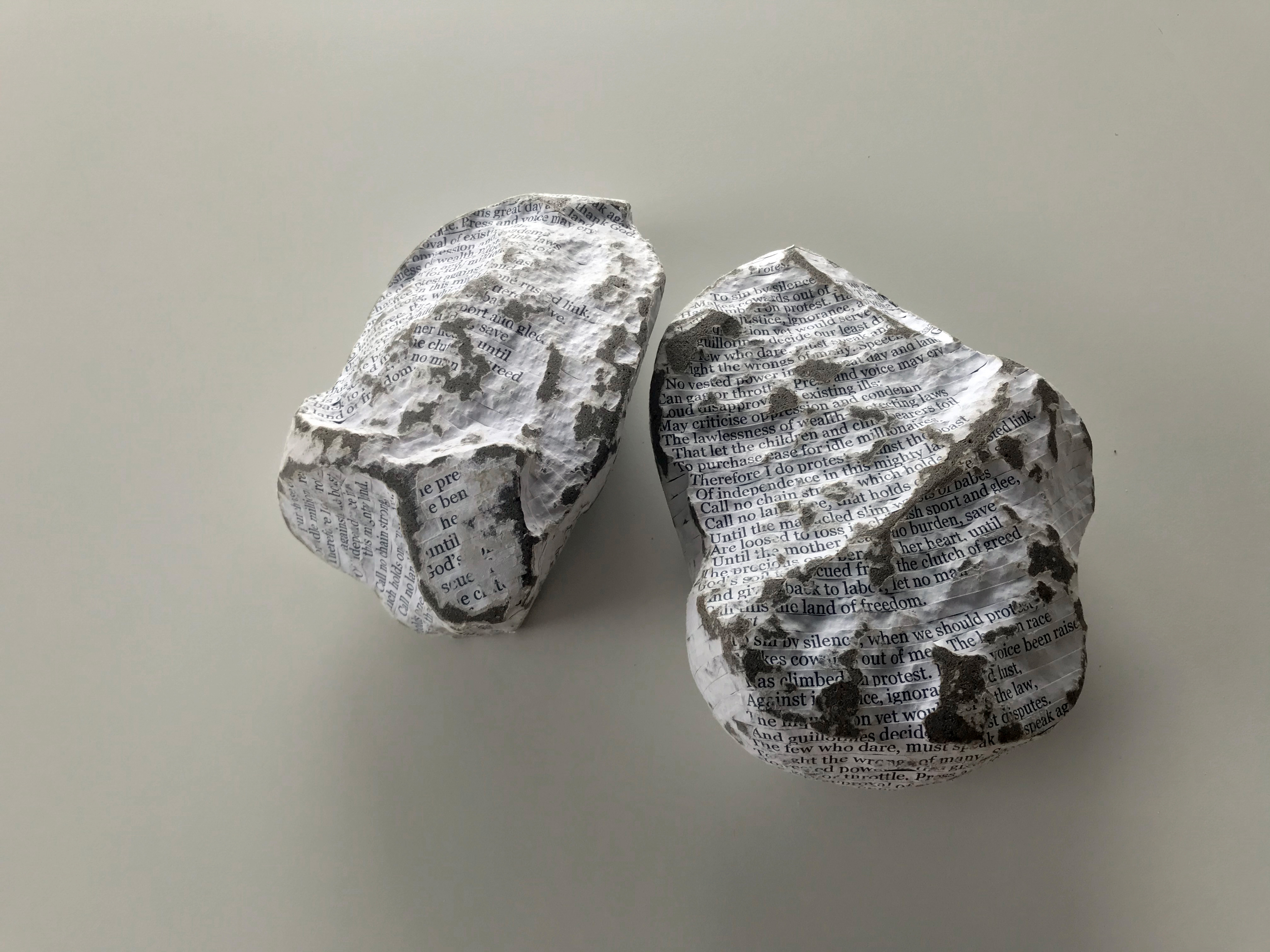
Poetry-wrapped protest stones, one for each pocket ready to be thrown.


No


No: a poem by Emily Dickinson, 2 poetry-wrapped stones, left stone: 12.5 x 12.5 x 7.5 cm, right stone: 10 x 12.5 x 5 cm, 2020.

Protest

Protest: a poem by Ella Wheeler Wilcox, 2 poetry-wrapped stones, left stone: 9 x 12.5 x 5 cm, right stone: 10 x 12.5 x 4 cm, 2020.

Riot

Riot: a poem by Gwendolyn Brooks, 2 poetry-wrapped stones, left stone: 10 x 12.5 x 7.5 cm, right stone: 7.5 x 12.5 x 7.5 cm, 2020

Born in Lisburn, Northern Ireland, in 1959, Stefana McClure received her BA from Hornsey College of Art in London and continued her studies at Kyoto Seika University in Japan. She lives and works in New York. Recent solo exhibitions have been held at Josée Bienvenu Gallery, New York (2018); Bartha Contemporary, London (2017); Sleeper, Edinburgh, Scotland (2017); and Arróniz Arte Contemporáneo, Mexico City (2015). McClure has been included in numerous museum exhibitions, most recently Useless: Art Machines for Dreaming, Thinking, and Seeing, curated by Gerardo Mosquera, at The Bronx Museum of the Arts, New York (2019). Her work is included in many public collections including: The Museum of Modern Art, New York, NY; Fogg Art Museum, Harvard University Art Museums, Cambridge, MA; The Museum of Fine Arts, Houston, TX; The Yale University Art Gallery, New Haven, CT; Staatsgalerie Stuttgart, Germany; Museum Folkwang, Essen, Germany; Kunstmuseum Bonn, Germany; and The Machida City International Print Museum, Tokyo, Japan.

Mez Breeze

A Place Called Ormalcy

“A Place Called Ormalcy” is a dystopian fiction comprised of seven short text Chapters combined with embedded 3D tableaus. The work is designed to be viewed on mobile devices and desktop PCs. The story of “A Place Called Ormalcy” unfolds through a series of snapshots of the life of Mr Ormal, a law-abiding citizen who resides in the aesthetically cartoonish world of Ormalcy: Ormalcy exists in an alternative universe complete with its own idiosyncratic language patterns. The world initially presents as Utopian, and full of innocent “claymationesque” contented creatures and happy denizens, but as the story creeps along it becomes apparent that in actuality, this allegorical fiction in fact traces the makings of a disruptive dystopic society, one where citizens are forced to comprehend what can happen when trapped inside their own homes for the sake of their ‘safety’. It illustrates how fascist principles can arise in the most benevolent of places – the story emphasis lies with how nefarious a process this is, and how this disrupts all.

«Ένα μέρος με το όνομα Ανονικότητα» είναι μια δυστοπική μυθοπλασία που αποτελείται από επτά σύντομα κεφάλαια στα οποία έχουν ενσωματωθεί τρισδιάστατα tableaus. Το έργο είναι σχεδιασμένο για φορητές συσκευές και ηλεκτρονικούς υπολογιστές. Στο «Ένα Μέρος με το όνομα Ανονικότητα», η ιστορία ξετυλίγεται μέσα από μια σειρά επεισοδίων στη ζωή του Κυρίου Ανονικού, ενός νομοταγή πολίτη που κατοικεί στον κόσμο της Ανονικότητας όπου όλα έχουν την αισθητική κινουμένων σχεδίων: η Ανονικότητα υπάρχει σαν ένα εναλλακτικό σύμπαν με τα δικά του ιδιοσυγκρασιακά μοτίβα γλώσσας. Ο κόσμος αρχικά μοιάζει Ουτοπικός, αλλά όπως ξετυλίγεται σταδιακά η ιστορία γίνεται σαφές ότι στην πραγματικότητα αυτή η αλληγορική μυθοπλασία ιχνηλατεί ουσιαστικά την κατασκευή μια παρεμβατικής ουτοπικής κοινωνίας, στην οποία οι πολίτες είναι υποχρεωμένοι να κατανοούν τι ενδέχεται να συμβεί αν παγιδευτούν μέσα στα ίδια τους τα σπίτια στο όνομα της «ασφάλειά» τους. Απεικονίζει τον τρόπο με τον οποίο οι φασιστικές αρχές μπορεί να αναδυθούν στα πιο καλοπροαίρετα μέρη – η ιστορία δίνει έμφαση στο πόσο φαύλη είναι αυτή η διαδικασία και πόσο αναχαιτίζει τα πάντα.
Μετάφραση: Δήμητρα Ιωάννου

Please, follow this link to watch “A Place Called Ormalcy:”

http://mezbreezedesign.com/vr-literature/a-place-called-ormalcy/

Mez first started deep diving into the Internet in the 1990’s to create digital works and she hasn’t slowed since. In 2019, Mez’s Virtual Reality Series V[R]ignettes won the 2019 QUT Digital Literature Award and Mez was awarded the 2019 Marjorie C. Luesebrink Award which: “…honors a visionary artist who has brought excellence to the field of electronic literature.”

Socrates Stamatatos

F*CK THIS COP(ING) MECHANISM

This performative collage/meme depicts the dysphoria that the police brutality creates in Greece. During the pandemic, the search for coping mechanisms in order to survive is desperate. While striving for emotional balance, the government pushes our limits further by strengthening the fear of existing in public spaces. To establish their fascist agenda, they conceal police brutality as their coping mechanism for COVID-19 outbreaks.

With the government monitoring our every move, the burden of creating safe spaces and healthy coping mechanisms becomes a personal matter. Being more than 5 months locked down, getting banned several times on social media, fearing a potential attack while collectively marching, builds a solitude chamber for each subject. The need for solidarity can’t be easily approached, or when it does, it comes with great cost, and gets stripped away eventually.

The Greek government not only vilified social media, by verbally attacking them and consistently banning people’s actions there, but they spent a significant amount of money on the Greek Media( ex. Major tv networks) to promote their agenda and far-right actions. As a result there are not many spaces left to exist, create, get informed, protest.

Being Queer in Greece and taking under consideration the massive attacks on several of our rights, the fear of being present in public places no longer seems like a dystopian nightmare. The nightmare transformed into reality with the collective memory notifying us that this common experience resembles a contemporary junta.
At the same time, the need for self care and coping with this junta keeps getting bigger every day. From a personal perspective, napping is the only outlet left as it creates an embracing and caring space, free from dysphoric thoughts and from being constantly bombarded with new unpleasant information.

Socrates Stamatatos is graduate from the Athens School of Fine Arts, Department of Theory and History of Arts with research focused on contemporary and queer arts. He has worked as an art mediator and assistant curator with many art organizations, such as the non-profit cultural organization NEON. He/She was also part of “FILOTIMO” a project commissioned by the Dutch based magazine “Are We Europe”. The project was nominated as a top recommendation by “The Guardian”. As a drag artist he/she has strong presence in the arts sector and has worked in many projects commissioned by various Greek cultural institutions, such as the Athens-Epidaurus Festival and the Greek Ministry of Arts,Culture and Sports to name a few.