
Christine Stoddard is a writer, artist, and founding Quail Bell Magazine editor. Her work has appeared in the Queens Museum, the Condé Nast Building, the New York Transit Museum, and beyond.

Christine Stoddard is a writer, artist, and founding Quail Bell Magazine editor. Her work has appeared in the Queens Museum, the Condé Nast Building, the New York Transit Museum, and beyond.
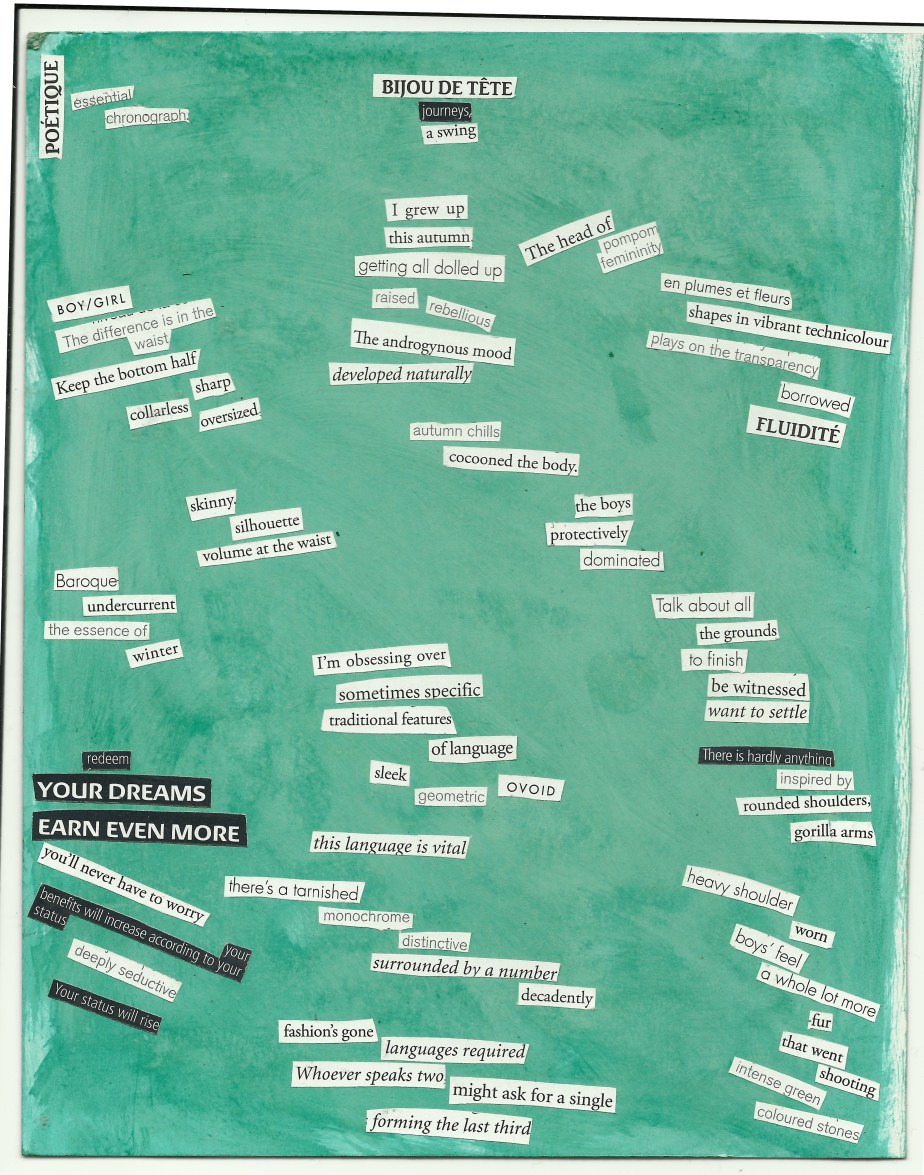
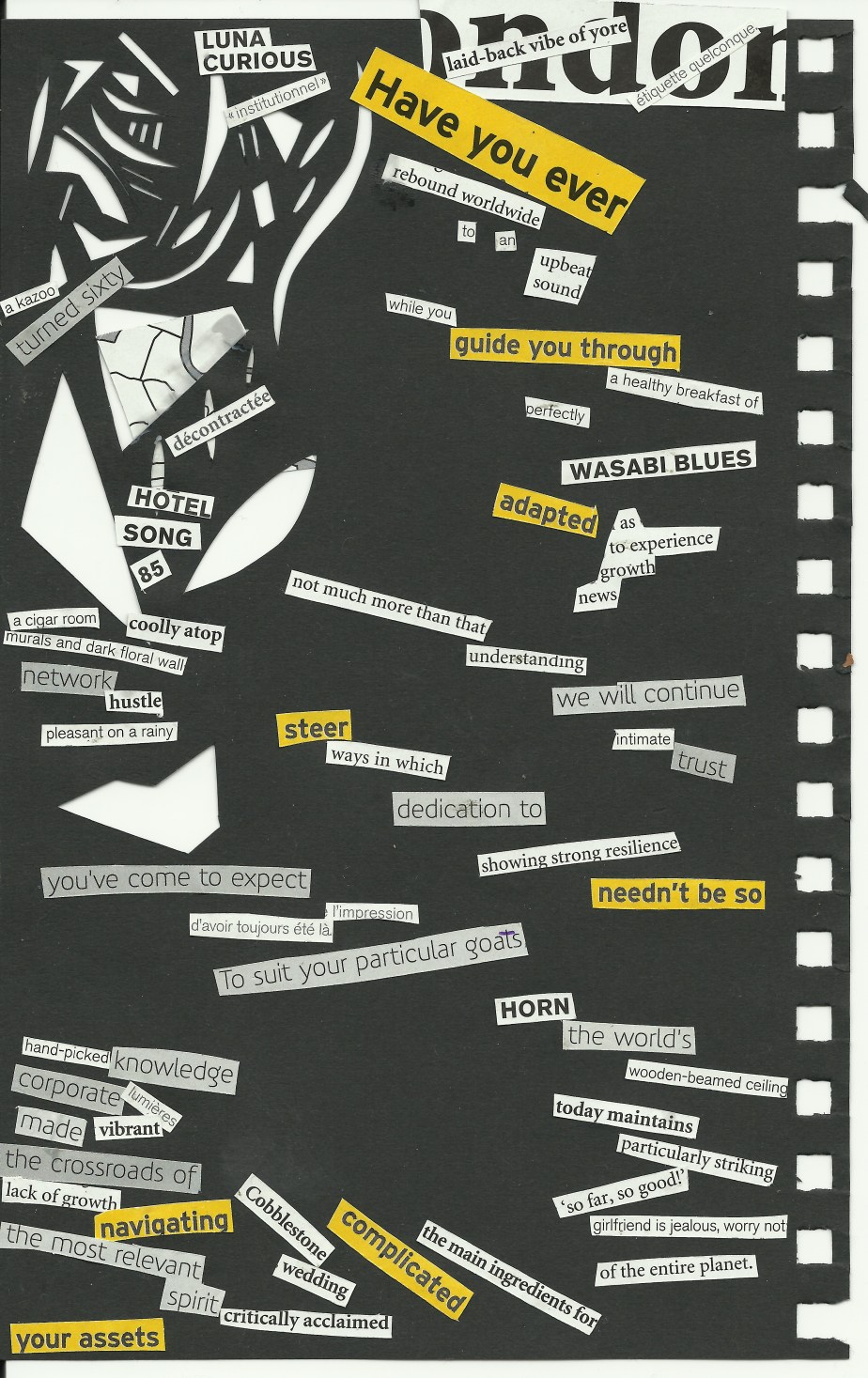
Florence Sunnen is a collagist and short story writer from Luxembourg City. She spent five years as a postgraduate at the University of Warwick, where she recently completed an MFA project. Her work draws from her multilingual upbringing, and searches for a middle ground between creative writing and philosophy. Currently, her favourite poet is Claudine Toutoungi. Florence’s work has appeared in Datableed and The Learned Pig. She lives in Coventry, UK.

intro
Night by night, I find myself a little more or a little less mutable.
Now now. Pause. The outside melts on the inside.
A poem based on movements and migrations of people across borders.
Trajectories, diseases, and dance language.
The rain ciphers. Rituals morph.
Bodies might become nebulae or verses, and notes.
You will find all these mutations, their moments, phases, imprints, sensations, and nuances to the brilliant works of Louisa Doloksa, David Felix, Amy McCauley, John Morgan, Maria Petrides, Lauren Samblanet, Erica Schreiner, Shakeema Smalls, and Jenny Wu. Many thanks for making this fascinating issue on Mutability.
Enjoy!
Dimitra Ioannou
On Superpowers and Beautiful Women
Question: If you could have any superpower, what would you choose?
Answer: I wish I could transform myself into a beautiful woman. I would like to know what it feels like to walk through life with the certainty of beauty, the certainty of womanhood. I would then live a year of my life as a beautiful woman. I would shine bright, seduce and destroy and I would be loved, because I would be a beautiful woman. After a year, I would return to myself, and only think about having been a beautiful woman from time to time. The thing I am, the comfort I take in its excess and lack, is not worth sacrificing, for the sake of a beautiful woman. Still, I wonder, what life would be like for a year as a beautiful woman.
Answer: If I could have two superpowers, I would turn back time and relive select incidents, or even my whole life as a beautiful woman. Take careful notes. Before I turned back time and relived my life as a beautiful woman, I would have taken careful notes too. I suppose , I would turn back time, relive my life, take careful notes up until my decision to relive my life as a beautiful woman, then turn back time and relive my life as a beautiful woman, all the while taking notes. Would I still take notes as a beautiful woman? Do beautiful women take meticulous notes, do they have the time, do they have the strength, the patience for meticulous notes in the midst of the world’s constant demand for their beauty?
Answer: If I could have three superpowers, I would turn back time and relive my whole life as a beautiful woman who could ward off people’s desire with one hand, spin it with the other, and take notes with the other. Then I would compare notes. I would then like to meet someone who also has superpowers. Someone with the ability to transform me into a rather small, invisible nebula. I would enjoy spending eternity, eternally combusting amidst the charred pages of my notes, visible only to myself and through reflection, but capable of sound, particularly of meaningful whispers. I would whisper my observations to others who like I once was, would not be a beautiful woman. I would take every step to assure them that they are not going crazy before I told them my observations. I would introduce them to the right people. I would soon have company, maybe even lovers. We would all compare notes. If we had fingers, they would have been sooty, from exchanging each other’s charred, meticulous notes. If we had bodies, they would have been sooty, from rolling around, and biting, and scratching and licking and sucking and pulling and lightly caressing each other, on a bed of our compared, charred, meticulous notes. That we had once lived our lives as beautiful women, will matter much less than that we have lived our lives not as beautiful women.
Thank you for your questions.
Louisa Doloksa is a bowel artist, poetess and performative fattie. She enjoys talking about her empathy related bowel issues, her emotions, and the political experience of fat femininities.
Phylum

Bell rung
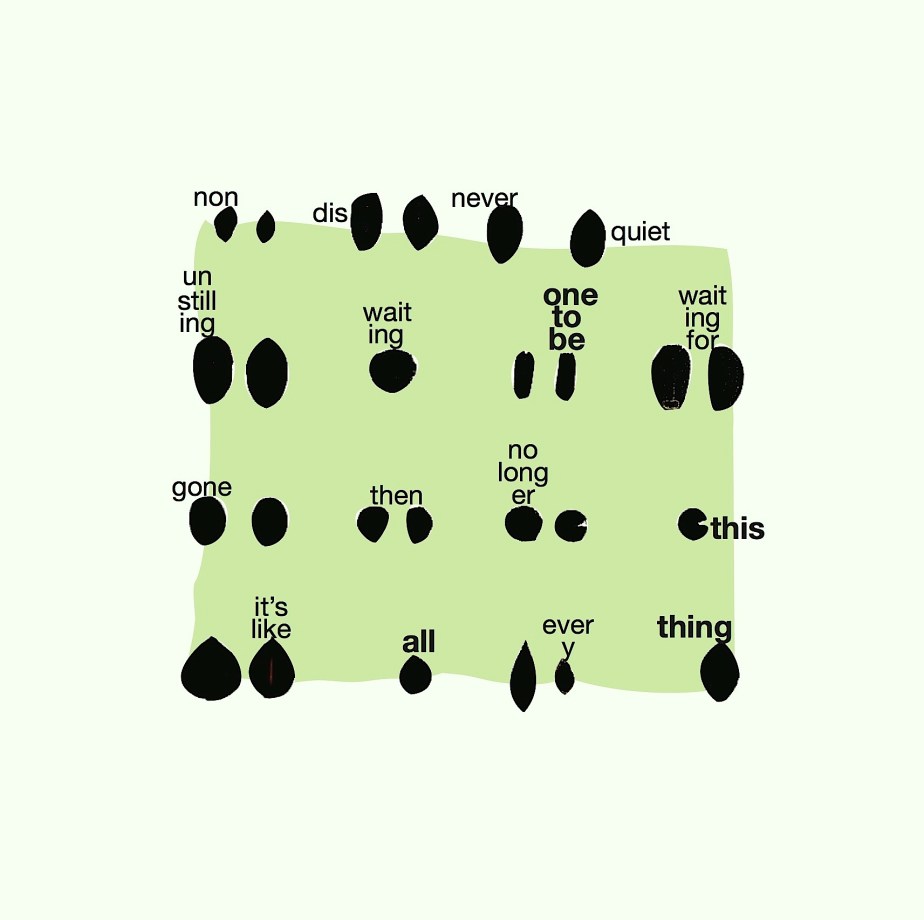
Ampersand

David Felix is an English visual poet who lives in Denmark. For fifty years or so his writing has taken on a variety of forms, in collage, three dimensions, in galleries, festival performances and video and in over thirty publications worldwide, both print and online. Born into a family of artists, magicians and tailors he still maintains a professional working relationship with a life model, the materializing lady and a fitting assistant.
do you love me enough to ruin my life & / or lay me out
sparingly I / my desire only increases not mine you said I had to
grieve so I will do my best but / I want to happen like there’s no
such thing as repetition or / [did we really love without asking
whether we knew how not to hurt / who hurt / who knows each
other & / or oneself who / knows] // pause // but tell me why do
you dance & who are you dancing for [shut up you sleaze
okay / okay / okay] // pause // I took care , you see , to fill my
life with such miserable intimacies I didn’t feel what / well /
appalled at what / [who] / how I did but did I ever know desire
until now [look , it’s only grief dressed up in gladrags & how it
parades its stench of meats & spills the double-backed bedbeast
verily steaming down its plinth! I / I should really send you a
long way away you poor incendiary thing o , a thing to hold on
to like pleasure] // pause // now I shhh tread softly to the
downbelow devices & trawl your extant hungry smudges in the
bawled-all-over & trembling [o , the traps you set for my
cheapness / such is the failure of sincerity o , & the parapet of
your affect!] // pause // now / now / now the curtain rises & all
your dreams go public on a million infamous nobodies [you
must not cry / it is forbidden to cry] & may this wanting you
stop / never stop but Christ how lonely the living are in the
early faces dawn talking god / soaps / war & all privacy is
theft / against your will / my will / nothing like life // pause //
why won’t you come home & give me your love-diseases
the time I let my mouth out was a very bad time & in some
things Ma had a point but god knows she made that point with
an aggregate rage like / rage was a matter of fact thing or the
raft she clung to or the ultimate state of existence & / yes
according to her I had no business with things like feelings & in
that respect hers was a hit & run love or a bloody oil & knuckle
affair or // pause // a wound yes if anything Ma was a wound
the kind I was going to say that “keeps on giving” but can a
wound give / well if it gives I suppose it secretes which is
another way of saying displays & conceals for what is a Ma but
an impeccable mystery or allegory or // pause // the perpetual
suggestion of some unmentionable thing & its simultaneous
withholding or the answer to a question she devises under her
film which discharges / seeps / expels / oozes & if only this
weren’t the morning after the lifetime before & if only
the mouth weren’t a very bad time but it gives o yes it / gives but
when I say gives do I really mean takes & when I say wound do
I really mean // pause // & it helps to know what things are like
if only to feel the gap in the middle like // pause // simile were
an infinite generator of wounds / secretions / rages & the more
she takes the more she gives & what is a wound but that which
cannot wound itself
Amy McCauley works as Editor of Creative Response for the feminist visual arts website MAI Journal. She is interested in trans-genre writing, auto-frictions and feminisms. Amy’s first collection of poetry ‘Oedipa’ will be published by Guillemot Press in 2018.

John Morgan’s poems offer a visual engagement with real, imagined or received experience of landscape, place, identity and myth. His writing often responds in situ to the works of other writers and artists, as well as to the land itself and how it receives and ‘writes’ the identity of the person moving through it. His poems have appeared in a glimpse of, The Learned Pig and Reliquiae, but are mostly published on his own website, Visual [writ]/read/[/ing/]: http://users.aber.ac.uk/jpm/visual/words.html
beyond da ta
and the mile is smooth
like the Ionian sky
turquoise and
feathery
as the wind whistles
echoes
spring from the
searing seawater.
there to here, a
cornering line of
british barbed wire
bears vestiges of the
perforated ermou
caddesi
from UN wire to
unwiring this
naturalised protection
at any rate between
mili(tarrying) jets
flying low
and
moderate alerts
lying on car windows
autographed by the sovereign
authorities of akrotiri
DO NOT LEAVE
YOUR
PERSONAL
BELONGINGS
UNATTENDED
THANK YOU
ΕΥΧΑΡΙΣΤΩ
(TEŞEKKÜR EDERİM)
i smile
glassy-eyed
remaking
airport and subway
pronouncements
post 9/11
interposing my
freedom to choose
how i perceive
IF YOU SEE SOMETHING
SAY SOMETHING.
a US’s DHS’s
PSAs
aslant
detonate
dread
racial profiling
criminalising Muslims
guilty until feigning they are guilty
immigrants and refugees
now attacked by smart enforcement
transmogrifying
protection into
arrant
racism, islamophobia
we resist
and reverse fear
into tools
of emanating
empowerment, of
empathy.
stamboul’s
barbed fences
hem in and tear
Kurds, Trans Turks, Sex Workers, Roma, Immigrants
tarlabaşı’s communities
from neighbourging beyoğlu.
military tanks anchored in
the central quarter away from the boulevard
demarcating land and air
as buildings are demolished
and denizens evicted.
i’m arrested by the
monumental
gated-ness,
the gross capital
eating through Istanbul’s
zoned city
barging into
human bodies
reduced to human waste.
where am i,
traversing the caveat
of
new york
rio de janeiro
the kingdom
stamboul or cyprus.
in
king’s cross’
marks & spencer
a luggage is
lugged and
left erect,
the onliest
clitizen
awaiting
an eye-ray
unbeknownst
to its owner.
the queue
instantly
cut
by the
grunt of a brash
blue-collar
6-foot frigid
guard
IF YOU DO NOT
CLAIM YOUR SUITCASE
WE WILL REMOVE IT
AND THE STATION
WILL IMMEDIATELY
BE EVACUATED
HALTING TRAINS
LEAVING LONDON
the traveler incriminated
dropped the
generic
pret a manger something
on the fridge’s shelf
in flight for vanishing.
the freedom to suspect
is new law!
in october last
the
chronic coup in brasil
stumped its macho
neo-lib fist over
students
pardo and preto
poor and public
slashing subsidies
pauperising
social education.
over a thousand schools
across brasil were
occupied
frenzied and resolved
to oust temer.
FORA TEMER FORA
TEMER FORA
TEMER
the 1%
public parasites are
for a temer.
Bea Camila
Andressa Clarice Felipe
Joao Pedro Vitor Joaquim
and mucho others
occupied the colégio
estadual monteiro de
carvalho
in
santa teresa
for 7 months.
in the mean time
working computers never accessed
libraries of fortune in archives dug away
were spotted
on the floor
above the ground level
to which students were
confined when they
were (not)
occupying.
…
it breezed from the west.
what’s imminent in
every short moment ()
which terrorist, thief
or muscle?
In a flickering movement beyond,
a
twinkling vagary
emanates from an
azure at hand.
i
smile again,
a single smile
this time.
she flaps her wings
as i hum the ladybird away,
and she heads farther
west
to that military base.
…
Maria Petrides (b.1973, UK) is an independent writer, editor and translator. She has contributed to magazines/anthologies & art publications. She has participated as writer in residencies in NYC, Nicosia, Istanbul, Helsinki, Rio de Janeiro, Geneva, and curated/coordinated for Gowanus Studio Space, NYC, depo, Istanbul & The Breeder, Athens. She’s translator of Wow, a political comic book by Ariadni Kousela, Patakis Publishers & co-translator of Bill Ayers’, To Teach the Journey, in Comics, contributing author for the collection, A Book of Small Things & assistant editor for Evripides Zantides’, Semiotics: Visual communication II, Cambridge Scholars Publishing.
Η Μαρία Πετρίδη (γενν.1973, Ηνωμένο Βασίλειο) είναι ανεξάρτητη συγγραφέας, επιμελήτρια κειμένων & μεταφράστρια. Κείμενα της έχουν δημοσιευτεί σε περιοδικά/ανθολογίες & εκδόσεις τεχνών, έχει συμμετάσχει ως συγγραφέας σε residencies στη ΝΥ, Λευκωσία, Κων/πολη, Ελσίνκι, Ρίο Ντε Τζανέιρο, Γενεύη και έχει επιμεληθεί/συμμετείχει σε εκθέσεις στο Gowanus Studio Space, ΝΥ, το DEPO, Kων/πολη και The Breeder, Aθήνα. Είναι μεταφράστρια του πολιτικού κόμικ «Wow» της Χρύσας Ariadni Κουσελά, Εκδόσεις Πατάκη, συν-μεταφράστρια του «To να διδάσκεις, Το ταξίδι σε κόμικς» του Bill Ayers, και συγγραφέας στο A Book of Small Things ενώ είναι βοηθός επιμελήτρια του «Semiotics: Visual communication II» του Ευριπίδη Ζαντίδη.
From poltergeist residues: rituals for traumatic hauntings
Please click here to read: i. hive
lauren samblanet is a recent graduate of temple university’s mfa program. her poems have been published in a shadow map: an anthology by survivors of sexual assault, queen mob’s teahouse, the vassar review, walkabout and adanna. a dance-radio collaboration with skye hughes was published on colorado public radio’s website and her writings about dance can be found on thinkingdance.net.
Erica Schreiner is an experimental video and performance artist, writer and poet based in New York City. Originally from Oregon, Erica received a BS in Graphic Design from the Art Institute of Portland. Erica attended the School of Visual Arts Lens and Screen Art’s Residency Program. She also studied under the direction of performance artist, Marina Abramović at MoMA PS1, where Marina Abramović, Erica Schreiner, and 11 other performance artists shared a final performance.
Erica Schreiner has completed more than 60 performative video art pieces using a VHS video recorder, including Satori, a feature length film. She’s created music videos for: Soft Metals, Reba Hasko, JF Robitaille, The Crash Engine, and American Anymen, and Fierro Ex Machina.
Erica’s work has shown at the Bill Hodges Gallery in NYC. She been a regular contributor to Nick Knight’s SHOWstudio and has curated the SHOWstudio blog.
Erica published two books of short stories under her label, Analog Cinema. Hellos & Goodbyes (2009) and Arrows (2015) Illustrated by Nyssa Frank. Erica has written several zines, and can regularly be seen performing with the poetry community in NYC. Mad Gleam Press will release her debut novella entitled: The Greatest History of Life by the end of the year (2017). Also scheduled is a collection of poetry entitled: The Plastic Sea (Blue Pear Projects, 2017).
bushwick, 2017.
2.
scenes.
you walk out of the house
face painted in childhood murals
always RIP & 40oz. altars.
now hype spots for tourists
who, in derangement,
turn your shrines into
neighborhood character.
the home listings read:
‘Wonderful place to raise our kids’
‘Nice place to take a shower in the sunlight’
you wonder
if people still wash their asses outdoors
& whether the children are okay.
there will always be memorials.
*
4.
upright.
the first boy.
he had to be told
that pussy don’t smell
like burnt weave
& old sunflower seeds.
education.
it’s 2nd quarter
he knows how to
weave cord
keychains & twist
outs. they beat
him till he had
chainlink tattoos.
*
6.
race-face.
which negro spiritual
do we sing at yt cookouts
when faced with
polenta &
textured vegetable protein
speculatively cooked
in discarded pork fat?
certain that there exists
a word
for wading out too far.
not drowning. but integral
integrity integration
ingratiation inflammation
inoculation irradiation
interpolation.
*
8.
history.
I was at Plymouth Rock in 89
N heard all the banter
Right from the stage of
A basehead’s uterine lining.
I been a snitch since 88,
My eyes on the scuff marks
Of her sneakers
Legs way up in the air
And bowed in not-so-first love.
Primero, my father says.
Silly men do have strange memories.
But I was there
When the ship bumped
And the shit went down
N so when I talk about history, kid
You need to listen.
You got this game for free.
you got a lot
of people
fucking for ten-fold blessings.
in a manner of speaking,
every prosperity gospel
Is attuned to the saints
that deconstructed it.
mass media-in-res
hearings at the Throne
too many questions
our lord wonders
how a nation of men
comes to covet itself.
looking down upon us
children of the fallen
in all our prayers,
the smell of our
early morning tongues
braising the ears
of our protectors.
a holy ringing.
all of our kings
backpedal softly
across the chests
of our children
braided rugs,
patriotism
& self-loathing.
we never answer our blessings.
our shoes become untied
every step
towards the father,
liniments of verse
charted across our arms in vegetable ink
& trap soul discographies.
waiting to bury our rulers,
we got a lot
of hellish dreams
& purple hearts.
glxy.
hardest stuff to let go.
gonna wake
in a tub full of ice
knees bent for the day
veins shrunken &
no more of your juice
can be had. when,
perhaps, cold isn’t cold
anymore.
you begin
to miss daylight
your daddy
hollers off
the building stoop
you must need
something
on your head.
no more. but
you are turning kind
of blue. as if
you are getting younger
& less memorable
& now, you are
your mother’s space.
she carried you
light years before
her whole body
convulsed in withdrawal
but there was no solace
& you had to come
& die proper
in your sleep.
you dreamed so many
times
of laying into flesh
with everything, ceased
lights no longer burning
your eyes. the last time
you made a wish
on a star.
Shakeema Smalls is a writer from Georgetown, SC by way of Brooklyn, NY. Her work has appeared in Tidal Basin Review, Kweli Journal, The Fem, Blackberry: A Magazine, The Feminist Wire, Free Black Space, Sugared Water, Vinyl Poetry & Prose, and Muse, with upcoming work in Pittsburgh Poetry Review and Radius.
PORTRAIT OF THE ARTIST AS A YOUNG ARTIST
1.
When I used to live in the city I had a balcony on the twentieth floor. I discovered on a balcony diagonally above me there sometimes appeared, among the potted plants, a gray dog with a white M for eyebrows, and I would whistle up to him and whisper, “Hey, hey.” He would stick his long snout, then his whole face, through the railing and his ears would flop in the wind and he would glance around at the street, the sky, sometimes at me, and smile in the sunlight. I thought, “Hey, dog, are you having fun?” His gray fur matched perfectly the color of the stones of the building. Sometimes birds flew so close I thought he could bite them if he wanted; we really were way up in the air.
One morning I was out there again, and I noticed this dog had gotten on the ledge. I whistled, he glanced at me, he glanced at the street. Before I could even wonder he had leaped to his death.
2.
The egoist’s sonnet: “I am, I am, I am, Iamb, Iamb.”
3.
People like to say there was something in the water of America. There was talk of social diseases. An old local politician was revealed to have sat in his seat in the governmental assemblies for thirty years without speaking out once. He was shy.
Zimbardo’s studies on shyness show, from their perspective, doctors and psychologists and theorists, who were not shy, prodding and yelling at shy test subjects, verbally beating them into effeminate submission. Nearly 1 out of 2 American adults in 1975 confessed, in an anonymous study, to being shy; at first this was classed as a neurosis, an anxiety, a cognitive problem caused by some insidious socio-biological decline in Americans, especially American men. What followed were humiliating studies in which shy people were forced into parties and scrutinized, much like they already suspect they are being scrutinized.
The researchers suspected that people were overestimating their shyness; maybe not half but only 1% of men are actually shy, they postulated. They sought out the 1% who were so shy they could not leave the house, who had driven themselves crazy. This 1% was easy to spot in a crowd.
The researchers studied shy children and decided that adult shyness is a case of arrested development, cowardliness. Then the scientists compiled their evidence and began to fear that actually 100% of all people have traces of shyness in them; they themselves noted, at a scientists’ convention, moments of their own unease, when waiting in line at the coffee station, during silences in conversation with those obviously ill-matched for conversation (whether due to differences in intelligence or specialization). They began to fear that the disease was spreading, started spending nights partying (one party lasted 72 hours straight), laughing and dancing just to prove their worth, their charms, their wiles.
4.
A wall on which someone has written, “All walls must fall.”
5.
Marc, an amateur director, got people who weren’t actors together to make a film. The script was full of wine-party scenes, full of cigarettes as props, since Marc didn’t really know how to write yet; the scenes were really just exact replicas of real life. (Really the script was just a bunch of people standing around talking about how they felt.) But even though the “actors” were doing what they normally do anyway, they were tense and self-conscious, so Marc plied them with wine. The “actors” got drunk for real and started getting emotional, as though the lines and the drama of the script were real. Some related to their characters in powerful, inexplicable ways. Some wept. Some really did fall in love that night. Most, by the end, recalled something repressed, yet significant, from childhood and made some casual promises to devote their lives to art.
6.
“I’ve gotten better at reading poetry. I’ve gotten to the point where I can read a series of random letters, even foreign glyphs, and see a picture, grasp a meaning. The best poets can read an oriental rug.” Marc was extremely high and enamored by the rug he was sitting on. It looked, in terms of a feeling, exactly like Matisse’s red studio.
“To accurately plant an image in the reader’s mind, you must express things a tad inaccurately. In order for the reader, for example, to see Gregor Samsa as a man, the reader must first see him as a bug. In order to convey that something was merely okay, one must necessarily say, ‘It was phenomenal; no, it was deplorable.’ If the reader is imagining a beautiful woman, the writer behind the curtain is no doubt describing, in fact, in the most realistic terms possible, the coloration and softness of the skin of a peach. If the writer says ‘one thousand years,’ the reader perceives one pregnant second. In order for a reader, for example, to envision a copper-colored room, one must describe it as a rose-colored room. This problem concerned Duchamp.”
—Marc, On Imagination
“A small discrepancy in data of one or two units out of millions, accreted over a million years, becomes a big discrepancy.”
—Marc, On Time
“There are some people with fundamentally disoriented minds. They’re the ones who do not equate north with up and south with down. They will say they are going ‘down to New York,’ or going ‘up to Miami.’ I do not trust such people. Really though, you can say you’re going ‘down’ to Miami but you can’t say you’re going ‘up’ to New York. If you believe that you’re standing up straight on the spherical earth then you are always at a point where going anywhere means going down.”
—Marc, On Space
“What is it to read poetry? True poetry gives you a feeling even if in a foreign language, even if language-poetry, even if concrete poetry letters scattered across the page. Read the pattern on the rug and get that poetical feeling. La lingua ch’io parlai fu tutta spenta / innanzi che a l’ovra inconsummabile / fosse la gente di Nembròt attenta.”
7.
Marc was in the hospital, and all he wanted to do was listen to gameshows and P. J. O’Rourke on the radio. I thought often about the dog on the ledge; in my mind there was a film reel constantly replaying the image of a dog falling head-first, inch by inch, down the facade of a building in grayscale.
Marc had cancer. I sat by his bed: an attempt to comfort my friend by listing all the names I knew of great men who also died of cancer.
“Matisse had cancer of the stomach.”
“Is that so…”
“Rilke, I believe, succumbed to leukemia.”
“Mmm.”
“Napoleon, too—a great man—again, stomach cancer.”
Jenny Wu lives and teaches in St. Louis. Her recent stories appear or are forthcoming in The Ogilvie, Dream Pop Journal, Pour Vida Zine, and elsewhere.
intro
Sometimes I feel allegories are reality, and that reality has yet to begin. The brilliant allegories of resistance, and transformation that inhabit aglimpseof’s pages contain guising, irony, projections, melancholy, anger, and recursions.
Clinton Craig wrote “Goldwater” at the same time as he was reading “The Yellow Wallpaper” by Charlotte Perkins Gilman: “I was inspired by her character’s interior reality, a reality that she was so sure was true, yet was told constantly was simply a hysteria. I don’t know how Gilman would feel about my appropriation of her work, but it was done with great respect and a feeling of urgency spurred by the current political situation (of alternative facts, egocentrism, and rejection of logic) in the United States.”
The texts that Jazmine Linklater used for her collage poems are Freud’s “The Question of Lay Analysis” (Neurose), Camus’ “The Myth of Sisyphus,” Thomas Nagel’s “The Absurd” (Absurde), and Sartre’s “Existentialism and Humanism” ( Foi).
“By appropriating a linguistic corpus of spam trigger expressions,” Bruno Ministro is “alluding to the performative aspect of words, which are symbolically considered forbidden or allowed by those machinic-built spam filters. What does it mean to be forbidden/allowed in our society? Does this generator work as an true allegory of culture?” This spam generator is for Bruno Ministro “an allegory of all the weird junk people upload to the web, particularly, to social networks. It is somehow what Sandy Baldwin refers to as ‘anomalous web materials.’”
John Morgan started making hand made concertina books on high quality laid paper for his long poems. “From a Stolen Voice” became one of them: “It responds to the idea of differential texts (Marjorie Perloff), where the layout and medium can provide distinctly different reading experiences. Holatyn is one of the old Jewish shtetls that have completely disappeared in western Ukraine. The reference here comes from a novel by Czech writer, Ivan Olbrecht, who uses the name Holatyn in the first chapter of his novel, Nikola the Outlaw (1933), set in WWI in Ruthenia, the region that bordered Slovakia, Ukraine, Hungary and Romania. He refers to it as a mountain in the Carpathians.”
Tom Snarsky’s “Poem” began “as a few unrelated quatrains composed with an 8-syllable line and grew to be a longer meditation on birth and music under the (in?)auspicious sign of mathematics. The poem’s conceit is the Garden of Eden Theorem for cellular automata, which states roughly that an automaton only has a true beginning state (that is, a state with no possible predecessors — a “Garden of Eden”) if that automaton has two states with identical sets of successor states (these are called “twin” states). The poem attempts to explode the kernel at the heart of this theorem outward into history, suspending the usual problematic of birth/origins/creation in favor of the play of twinning & experiment; in so doing, the poem evokes figures like Spinoza, Laurence Sterne, and Alfred Schnittke — all of whom happen to share a birthday. Ultimately, “Poem” tracks a fragmented effort to listen carefully, to attain subjectivity, and then to transform history — or, at the very least, to face the world and speak.”
Many thanks to Mary Alexi, Clinton Craig, Jeremy Hight, Allison Hummel, Anna Lascari, Jazmine Linklater, Erin Lyndal Martin, Bruno Ministro, John Morgan, Tom Snarsky, and Theadora Walsh who made the Allegorical issue deliciously, intriguingly, extremely real.
Dimitra Ioannou
(που η πριγκίπισσα δεν κατάφερνε να κοιμηθεί γιατί κάτω από το στρώμα της υπήρχε ένα δόντι)
Έβγαλα το φρονιμίτη μου
πιθανώς τον τελευταίο.
Έχω βγάλει τρεις, όλοι στραβοί.
Toυς άφησα σε καίρια σημεία για τη νεράιδα
η Νεράιδα είναι καλή
η Νεράιδα είναι στωική
η Νεράιδα είναι στοργική
η Νεράιδα παίρνει κομματάκια αίμα οστά και ούλα και τα κάνει χρυσάφι.
Ο πρώτος δε με πόνεσε, βγήκε ακέραιος
Η Oδοντίατρος τον άφησε δίπλα μου πάνω στο αποστειρωμένο τραπέζι.
Η Oδοντίατρος είναι προσεχτική
η Oδοντίατρος έχει ελαφριά χέρια
η Oδοντίατρος είναι για όταν ο φρονιμίτης είναι για να βγει ακέραιος.
Τον πήρα στην τσέπη του μπουφάν μου, έκλεισα εισιτήρια, γύρισα σπίτι
τον ακούμπησα στο μαξιλάρι του πατέρα μου, έκλεισα εισιτήριο, γύρισα πίσω
ένα δόντι λιγότερη.
Η Νεράιδα τον μάζεψε και ένα μήνα μετά ο πατέρας μου με πήρε τηλέφωνο.
Ο δεύτερος δε βγήκε ποτέ, μόνο έσπρωχνε και έσπρωχνε
παράλογα.
Ο Γναθοχειρουργός είναι λεπτομερής
ο Γναθοχειρουργός είναι αποφασιστικός
έβγαλε σε τρία κομμάτια κάτι που ίσως γινόταν δόντι
το ακούμπησε σε τρεις χαρτοπετσέτες.
Γλίτσα, σάλιο, αίμα- τον έκλεισα σε ένα φάκελο και τον έστειλα στον πρώτο μου γκόμενο
με διεύθυνση κάποιο πάρκινγκ και παραλήπτη μόνο όνομα
γιατί είχαμε πιεί αρκετά και δε θυμάμαι πολλά εκτός από τα αίματα στο κάθισμα.
Η Νεράιδα δυσκολεύεται να παρκάρει
η Νεράιδα έχει θέμα με την αντίληψη του χώρου αλλά
νομίζω ότι τον βρήκε
γιατί ένα μήνα μετά μου δώσανε την πρώτη μου δουλειά σαν σερβιτόρα.
Λάκι μι.
Η Σερβιτόρα είναι πειθήνια
η Σερβιτόρα δεν ξεχνάει
η Σερβιτόρα πάει στο Γναθοχειρουργό
να βγάλει ακόμα έναν φρονιμίτη
που κανείς δεν ξέρει αν έχει χώρο να βγει, αλλά πονάει
άρα αποφασίζουμε όλοι μαζί- ο Γναθοχειρουργός-
να σπάσουμε ένα κομμάτι οστού και να τον τραβήξουμε
να τελειώνουμε μια ώρα αρχύτερα.
Η Σερβιτόρα παίρνει ένα δόντι στις παλάμες της
που μοιάζει με τα πρώτα δόντια
που βγάζαμε μωρά
ένα φρονιμίτη νεογιλό
και τον φυλάει στο συρτάρι του μπάνιου
μέχρι να σκεφτεί τι θα τον κάνει
η Νεράιδα μπερδεύεται
η Νεράιδα πολύ συχνά δε σκέφτεται τις πιθανότητες
Έβγαλα τον φρονιμίτη μου και τον ξέχασα στο ντουλαπάκι της τουαλέτας
και το Σάββατο η Νεράιδα ήρθε να τον πάρει ενώ έκανα μπάνιο
η Νεράιδα είναι όμορφη
η Νεράιδα με έστειλε στο διάολο που την έβαλα να κάνει
τσάμπα ταξίδι
η Νεράιδα είναι κουρασμένη να είναι όμορφη
η Νεράιδα ήθελε να γίνει Γναθοχειρουργός
αλλά κανείς δεν τη ρώτησε
η Νεράιδα μπήκε στη μπανιέρα
έμεινα μαζί της, πήρα και τον φρονιμίτη μου
πλυθήκαμε
έφτιαξα καφέ κάναμε μερικά τσιγάρα πέρασε η ώρα
Τώρα
Η Νεράιδα και η Σερβιτόρα είναι άνεργες
η Νεράιδα είναι Γυναίκα
πίνει φρέντο εσπρέσο μέτριο και καπνίζει καρέλια πορτοκαλί.
Και
η Νεράιδα παίρνει σκουπίδια και τα κάνει θυμό.
Και, κυρίως,
η Νεράιδα είναι καλή
η Νεράιδα καταλαβαίνει.
Λάκι γιου:
η Νεράιδα θα σας στείλει στο διάολο αν την ξαναφωνάξετε
να μαζέψει το αίμα, τη γλίτσα και τα ούλα σας.
~
(The one with the princess not sleeping because there was a tooth under her mattress)
I had my wisdom tooth removed
possibly the last one.
This is my third one, all three grew crooked.
I left them on crucial spots for the tooth fairy to find
the Fairy is kind
the Fairy is tolerant
the Fairy is tender
the Fairy takes pieces of blood, bones and gums and turns them into gold.
The first one didn’t hurt, it came out whole.
The Dentist left it next to me on the sterilized table
the Dentist is careful
the Dentist is gentle
She is appropriate when the wisdom tooth is to be taken out whole.
I put it in my jacket’s pocket, booked a flight, went Home
I placed it on my father’s pillow, booked another flight, got back
a tooth less.
The Fairy picked it up. A month later my father called me.
The second one never grew, it kept pushing and pushing
absurdly.
the Oral surgeon is decisive
he removed in three pieces something that could become a tooth
he placed them on three different napkins.
Slime, spit, blood – I tucked them in an envelope and sent them to my first boyfriend
addressed to some parking lot and no last name
for we were drunk and I don’t recall much apart from the blood on the back seat.
The Fairy can’t handle parking very well
the Fairy struggles with the perception of space but
I think she found them
as a month later I got my first job as a waitress
Lucky me.
The Waitress is obedient
the Waitress does not forget.
The Waitress goes to the Oral Surgeon
to have yet another wisdom tooth removed
that no one knows if there is still place for it to grow, but it hurts
so we decide unanimously – the Oral Surgeon –
to break some bone and pull it out
to get it over with.
The Waitress holds a tooth in her palms
resembling something like
baby teeth
a wisdom tooth premature
she keeps It in the bathroom cupboard
until she figures out what to do with it
the Fairy is confused
the Fairy doesn’t often think of the possibilities.
I had my wisdom tooth removed, I left it in the bathroom cupboard
and forgot about it
on saturday the Fairy came to pick it up, while I was in the shower
the Fairy is beautiful
the Fairy told me to go to the hell
for making her come all the way for nothing
the Fairy is tired of being beautiful
the Fairy wanted to be an Oral Surgeon
but nobody asked her
the Fairy got in the shower
I stayed, I even took my wisdom tooth with us
we showered
I made coffee, we smoked some cigarettes, time passed by.
Now
the Fairy and the Waitress are unemployed.
The Fairy is a Woman
she drinks her coffee with milk, and smokes marbloros
And
the Fairy collects trash and turn it into anger.
And, above all
the Fairy is kind
the Fairy understands
Lucky you:
the Fairy will tell you to go to hell if you ever call her again
to pick up your blood, slime and gums.
Γεννήθηκα το 1990, στο Ηράκλειο Κρήτης. Ζω στη Θεσσαλονίκη. Δουλεύω σε διάφορες δουλειές, γιατί πρέπει να επιβιώσω. Και γράφω πολύ, γιατί δεν πρέπει. Το πρώτο μου βιβλίο ποίησης, κυκλοφόρησε από τις εκδόσεις Πολύτροπον, με τον τίτλο «Αλάτι». Παλιότερη δουλειά μου βρίσκεται στο μπλογκ whatthefak.blogspot.com
I was born in 1990, in Heraklion, Creta. I live in Thessaloniki. I do a lot different jobs, cause I have to survive. And I write a lot, cause I do not have to. My first poetry collection, named ‘Alati’, was published by the publishing house ‘Polytropon’. Μy earlier poems are published in my personal blog whathefak.blogspot.com)
 aglimpseof.net