If in-authenticity was a perfume

Antonis Katsouris is a writer based in Athens.

Antonis Katsouris is a writer based in Athens.

Evangelos Kyriakos is a jewellery designer who has been experimenting with the image in a broader context. He considers that the creative procedure doesn’t apply to any predetermined rules & norms. One can always invent ways to give form to an idea. He has studied graphic design and jewellery design and making in Athens and pursued his studies in the jewellery design at the Istituto Lorenzo de Medici and Alchimia Contemporary school of Jewellery and Design in Florence. He has presented his jewels in exhibitions in Greece and abroad, which include NY, London and Vicenza. He lives and works in Athens. http://www.evangeloskyriakos.com
Zanga quarkingly hemorrhagizes integral cosmology memonic octaviously
agentically disquieting lightning-riffic genealogists and their hot seashells
hungarcious xenomorphic intelligentsia where the geometric profiles of all intelligences Galenize ecocentrizing your pungentations tactically hallucinogeneizing imaginophobia where caviaric paint space-antelopes thoughtless unthinkable images Obituating skeletoned to Fraser highwaying Perfect evil Dimensionless protening Eternal Consciousness To hypno-neurones, Astra Athenia of griga, lumbrous self-preservation, spiritual biologists: each tooth is an acromantic heart somingly manateeing thru acramanta corn puffs Affrodils pasteurized scapes of platelets tall-grassed by Luxembourgian sea petals Zoltan hot springs matroyoshka Delphi’s of xhumatic belongingness! zamboni laciniated kittens amnesiate while country sides are plagiarizingly hair-brushed by the tepid sewage of endophilia! Psychocentric chlamydia salamander encumberable probo-possibly I pray fervently to hypochondriac economies before bed staring at the ceiling some hrs later, drenched in the fantasy-prone personality of a yearless girl bridesmaid, who kicks the Bride of Christ’s pew in front of her a domination iatrogenizing the ageing of beings did I mention? humorously humidifying the retrogradation of spirit spores! Sonically-hydrated cloud dunes tossed between the salad thighs of Monetian islets “my armpits breathe out sea foaming sea cedars — sympostically sea cucumbers Air droplets are ingested by every pediatric non-being!” Penniless moguls who wrote the screenwriting for an intellectually talented, underachieving ménage a trois based on real events shackle the hot tub growth in my medullum to thinly combed pond scalps The Hiawathan woman, robed in a sari bought from a hot dog stand, at the laborers union, petitioning public-property for the mass production of the non-existence of suffering a pair of lice for each pre-Socratic element retch sunglasses on the equatorial brain chemistry of fortepianos skeletoned out of decaying wildlife dead spirits Sea lions sangranated from seven-allergic sap morbidly humorize the multitudinous miled monolith laundry basket laying on its craterous side Horses microwaved on moonscapic ceiling fans scraping off petechiae and the mind’s digital bacteria meter is Latinistically delayed and the infinite beings of sexuality pantasize in volleyball courts over flooded with menarche fluid ear lobe tree houses fundicate scaly wrists Crackling the door knob atrophied with ostracized moose mucosae, drug withdrawing home décor universes Teddies bubblingly dished in nanometric plagenic hives lose all control of their bodily functions! free-falling off an emaciated canyon of labels: a natural body without an element shared with humanness, a natural body without being informatically contaminated by humanness Evil demon ravens gutturally howl carcai chemically intertangled on miscarried judgement less social prisms
Tiana Lavrova is an eighteen year old avant-garde writer based in BC, Canada, with upcoming chapbooks via with dancing girl press and Grey Borders books in 2018.
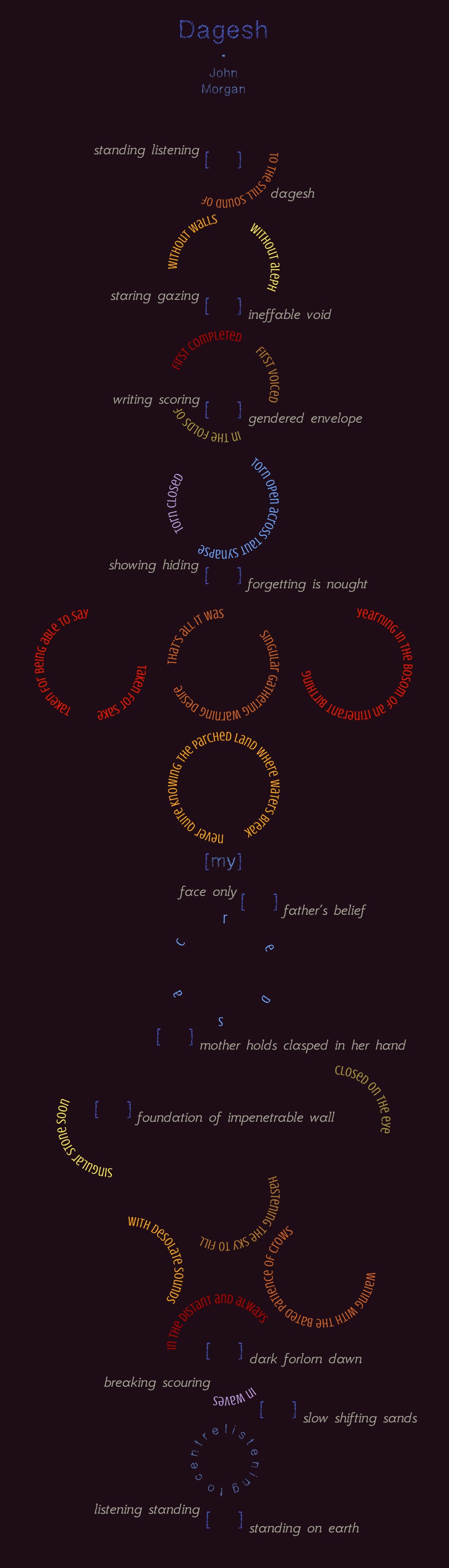
“Dagesh” is a very inauthentic view of living with Alzheimer’s, as it’s impossible to know how a person is experiencing memory, time and communication. The dagesh–the dot within the three sided Hebrew character (בּ)–as an unpronounceable symbol in its own right, is said to be an initial punctuation mark, rather than a final one (from Attention: A Short History by Joshua Cohen, Notting Hill Editions, 2013). Here, it is a mark given before the end that suddenly impacts the ability to communicate in a sequence the person has always been familiar with. The brackets being the erasure of identity of self and others that is so heartbreaking to see. The colours are all from flowers in the gardens where my Mum is living.
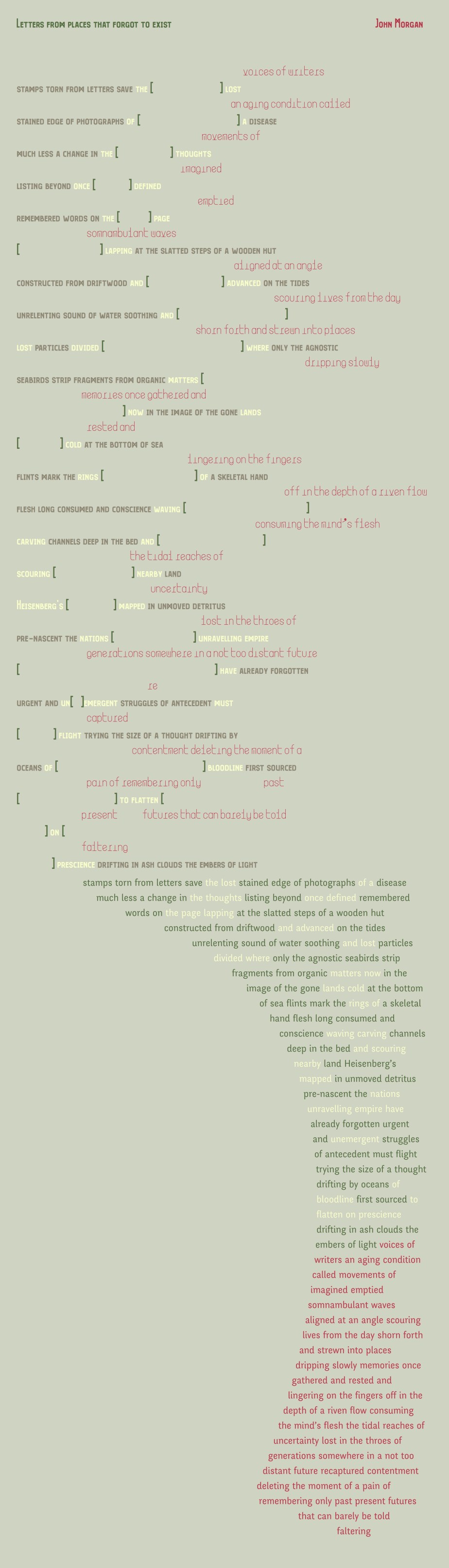
“Letters from places that forgot to exist” is inspired by an old stamp album found on a bookshelf where my Mum is. It listed Heligoland as a British territory, which I knew nothing about. It was ceded back to Germany in 1890. The interesting fact is that Werner Heisenberg formulated the uncertainty principle there, which states that the more precisely the position of a particle is known, the less precisely its momentum is known. Again this is a play on the movement of words between lines and parentheses, with the extracted words now bigger than the space they came from, pulling the eyes and attention in different directions, to be repeated at the bottom of the page in what seems like the “right” (distorted, wave-like) sequence, but is not. But who could say what the right sequence is? There is no temporal or linear sequence in the memories of an Alzheimer’s person*, as past and present collapse in on each other in a blending of real and imaginary. The faded colours are all from stamps and faded, yellowed pages in the album, with the pink and dark green being the colours of Heligoland.
* “Alzheimer’s person”: I learned that wording from the nursing faculty at a research hospital in Bangkok where I taught writing for nursing science research to their MSc students in 1998-1999. They used the word “person” very deliberately for people with AIDS, to avoid any sense of making them the victim, or to encourage families and society to not lay the blame on them for their condition. We live in an age where we pity people with such conditions, but some of the reveries that Alzheimer’s people have are really quite remarkable.
John Morganis a visual intermedial poet, who spends many hours walking in the mountains of Wales and other places, such as Laos, where “Each Field an Instant Haiku” is set. Each walk writes the landscape, histories, mythologies and people of these places, or perhaps each of these writes the walk. His poems appear in a number of editions of a) glimpse) of) and also in Corbel Stone’s Reliquiae journal and online digital supplement (Vol. 4) and in the Learned Pig’s “Wolf Crossing” editorial. The majority of his landscape-based works are available at his own website, Visual [writ]/read/[/ing/]: http://users.aber.ac.uk/jpm/visual/words.html
Iordanis Papadopoulos was born in 1976 and he lives in Athens, Greece. “Bras de Fer” (Gutenberg ed., 2015) is his second book of poetry. His most recent poems can be read in the anthologies “Kleine Tiere zum Schlachten. Neue Gedichte aus Griechenland” (Parasiten Presse, DE, 2017), “Futures: Poetry of the Greek Crisis” (Penned in the Margins ed., UK, 2015) and on https://burninghousepress.com/?s=iordanis+papadopoulos and http://bahiabahia.de/agathangelidou-papadopoulos-kationi/. He is also a member of the live art group “KangarooCourt”.
“Classification” is a diary of images – everyday images are collected in a collage and juxtaposed with one creature-monster image from Aldrovandi’s book Monstrorum Historia (1642). The work deals with the emergence of automatism, repetitive design principles and sequences of images of different interests, and indirectly with the problem of structuring order and classification.
Tomo Stanič (1982) graduated in architecture from the Faculty of Architecture Ljubljana in 2010, completed the MA program of sculpture studies at the Academy of Fine Arts and Design in 2016 and completed the doctoral program on theoretical psychoanalysis at the Faculty of Arts under the mentorship of Professor Mladen Dolar in 2017. He has written The Architectural Spectator (Arhitekturni gledalec), published by Studia Humanitatis. He has been a member of the editorial board of the magazine and publishing house Praznine since 2010. His writings has been published by the Praznine, ŠUM and Problemi magazines. Recently, he has lectured on contemporary art at the Museum of Architecture and Design MAO, Museum of Modern Art and Museum of Contemporary Art Metelkova in Ljubljana. He has participated in solo and collective art exhibitions, both at home and abroad.
Harun Tole was born in Munich. In 2007 he started in Kocaeli University as academic teaching assistant. He is still living in Kocaeli and continues his art practice. In his work he is attempting to create layers of multiple meanings by combining the audience’s own experiences with the enrichment of formalistic experiments as well as minimalist use of videographic and photographic images. http://haruntole.blogspot.com.tr
Chen Wang (China,1991) is an artist who lives and works in Rochester, New York. She received her BFA in Painting + Printmaking in 2014 from Virginia Commonwealth University and her MFA in Imaging Arts from Rochester Institute of Technology in 2017. She works prominently in video, hand-made costume, drawings, animation, performance and sound.
Jack Williams is a cross-disciplinary artist specialising in video art. His artistic and academic interests include: authenticity and audio-visual culture, urban screen culture and megacities. He graduated from Dartington College of Arts/ Falmouth University in 2012 with a First Class BA (Hons) in Writing. In 2014 he achieved an MA with Distinction in Film and Screen Studies from Goldsmiths, University of London. His work has been screened publicly at art events in the UK, France, Venezuela with further showings in Greece and Sweden later in 2018.
Symptoms can be significant tools. My early symptoms were too antagonistic, my later symptoms were too structural, and my recent symptoms are too predictable so I feed them up everyday for they should finish their business and move forward, where neither I nor they will specify the work that needs to be done.
Τα συμπτώματα μπορεί να είναι σημαντικά εργαλεία. Τα πρώιμα συμπτώματά μου ήταν υπερβολικά ανταγωνιστικά, τα μεταγενέστερα συμπτώματά μου ήταν υπερβολικά διαρθρωτικά ενώ τα πρόσφατα συμπτώματά μου είναι υπερβολικά προβλέψιμα, οπότε τα τρέφω καθημερινά για να ολοκληρώσουν τη δουλειά τους και να προχωρήσουν, εκεί όπου ούτε εγώ ούτε εκείνα θα προσδιορίζουμε την εργασία που είναι να γίνει.
Here, symptoms are part of a “long poetic sequence examining the historical and medical treatment of sick female bodies” (Dorothy Lehane). Moreover, poems express a “need for there to be rhythm in chaos while reflecting my understanding of that same chaos in the world” (Dan Leiser). Language itself becomes symptom; “voices stripped from their bodies” (Georges Mizithras), a “putrid discourse” (Iulia Militaru).
Εδώ τα συμπτώματα είναι μέρος μιας « ποιητικής ακολουθίας μεγάλης έκτασης που ερευνά την ιστορική και ιατρική θεραπευτική αγωγή των άρρωστων γυναικείων σωμάτων» (Dorothy Lehane). Κι ακόμα, τα ποιήματα εκφράζουν την «ανάγκη να υπάρχει ρυθμός στο χάος ενώ αντανακλούν τη δική μου κατανόηση αυτού του χάους του κόσμου» (Dan Leiser). Η ίδια η γλώσσα γίνεται σύμπτωμα· «φωνές απογυμνωμένες από το σώμα τους» (Γιώργος Μιζήθρας), ένας «σάπιος λόγος» (Iulia Militaru).
What symptoms are, and are not. What is the literary symptoms’ form? A list (Antonis Katsouris).
What symptoms are, and are not. What is the female character’s symptoms form? A fairy-tale (Daisy Lafarge).
Τι είναι τα συμπτώματα και τι δεν είναι. Ποιά είναι η φόρμα των λογοτεχνικών συμπτωμάτων; Μια λίστα (Αντώνης Κατσούρης).
Τι είναι τα συμπτώματα και τι δεν είναι. Ποιά είναι η φόρμα των συμπτωμάτων ενός θηλυκού χαρακτήρα; Το παραμύθι (Daisy Lafarge).
There are more symptoms here ‑ consuming & consumed. Many thanks to Maria Andreou, Ed Garland, Clive Gresswell, Antonis Katsouris, Daisy Lafarge, Pal LaFountain, Dorothy Lehane, Dan Leiser, Iulia Militaru, and Georgios Mizithras for their intriguing symptomatic works.
Υπάρχουν περισσότερα συμπτώματα εδώ, που αναλώνουν και αναλώνονται. Ευχαριστώ πολύ τους Μαρία Ανδρέου, Ed Garland, Clive Gresswell, Αντώνη Κατσούρη, Daisy Lafarge, Pal LaFountain, Dorothy Lehane, Dan Leiser, Iulia Militaru και Γιώργο Μυζήθρα για τα συναρπαστικά συμπτωματικά έργα τους.
Dimitra Ioannou // Δήμητρα Ιωάννου
(a service)
Me the host
Sometimes I think there is someone living in my eye,
so they see what I see,
and I think for what they see.
That is the only near logical explanation I have
for a singular image split into
two realities.
That I host,
and you visit.
(a sound poem)
measure/pleasure
erasure for pleasure
pleasure in erasure
erasure in pleasure
pleasure for erasure
measure the erasure
erasure in measure
erasure for pleasure
pleasure in erasure
erasure in pleasure
pleasure for erasure
measure the erasure
erasure in measure
Maria Andreou is a visual artist whose primary medium is language. Her research and work centres around the idea of how the art object can become the ground where praxis and poiesis intersect. When language does not manifest physically she still writes. http://www.mariaandreou.com http://www.twitter.com/demenagerie
POST EQUILIBRIUM GLISSANDO SHITSTORMS
a guaranteed presence, a flattened wave of gloss flowing always over not all of the interior – scupper the fat chance of detecting the nice to detect – provide a useful phenomenon to aid meditation but – input being no predictor of output – habits, tendencies – a large yes, a useful thud – not for hereby officially everyone – conjunction with tonal abrasion therapy – less than 50% cotton – planet are these people – a chorus rubbed into the gums or grey area classics under the tongue – Logos, Kaitlyn Aurelia Smith – yearns, craves, on a threshold below which it never – Bang & Olufsen impossibility – inheritance, theft, and accidental acquisition – a parked whine, a stuck sting – the curve and thrust of lips – likelihood of irregular gobbling – emitting bright wire from the ears – renovated in poor taste – considerably more irksome – mist being visible silence the last thing he insisted – looped snarls as declarations of agreement – conjunction with sine clusters, low frequency phase-bathing, ambient tendrils or sludge curtains – persisting through every interaction and lack of interaction – supervision of a proper chief – lucid, but lacking acoustic wealth – more than 100 days, consult Mumdance
Ed Garland’s writing has appeared in Antic, The Found Poetry Review, and A Glimpse Of. He lives in Wales, and is studying for an MA in Creative Writing at Aberystwyth University.
Steve’s journey
at all this dysfunction — function
he trod (from) dislocation the strand
lolling on his tongue
a tantalizing
paragraph
(shorn)
he walked on
not (once) in harmony
projectiles on the periphery
a stolen moment
(from where the shards of grass)
moments melting in the weeds
(his eye glued to the door)
from where his footsteps came
his shadow (a patchwork)
caste into future domains
a spittle of language surrounded him
trapped him in the gauze
new housing developments splintered
into this vast & hostile swamp of nouns
the guard noticed in doggerel
the swift-release of adrenaline alsations
to silence seething pavements
Clive Gresswell is a 59-year-old London-based poet who comes out of the Writers Forum Workshop (New Series) based in Shoreditch and who did his innovative poetry MA at the University of Bedfordshire. He has been published in BlazeVOX, LondonGrip and Tears in The Fence and is due for publication on Dispatches and Adjacent Pineapple. Meanwhile he is trying to do more London readings and was recently a guest reader at the international Tears in The Fence Poetry Festival. His first collection, Jargon Busters, from which these poems come, was recently published by the innovative Knives, Forks and Spoons Press.
ALWAYS WELCOME*
– – there’s always some group-therapy for your literary symptom(s)
the aquarium of aphrodisiac aphorists
the minaret of manicured metaphorists
the nursery of nervous narrators
the parthenon of perfumed parodists
the clique of charismatic correspondents
the elysium of exhausted experimentalists
the arcadia of acrobatic acratics
the tea-party of timorous time wasters
the esplanade of eloquent essayists
the menagerie of myopic mythomaniacs
the brotherhood of barefoot bards
the pagoda of prosperous pessimists
the carousel of cacophonous critics
the hive of hilarious haiku-hackers
the maison of mesmerizing memoirists
the vacancy of vitriolic versifiers
the alcove of alienated appropriationists
the panorama of perilous poets
the exile of elusive elegists
the lifeguard of lilliputian laconics
the refuge of repressed realists
the quartet of quotable queers
the plaza of platonic plagiarists
the cabinet of colossal columnists
the glory-hole of gregarious ghost-writers
the circus of clandestine cynics
the unity of undefended utopianists
the eden of euphoric experts
the mass of miraculous mysticists
the diaspora of dilettantish diarists
the feather-bed of fairy-tale fetishists
the terminal of turbulent twitter-tricksters
the north of nocturnal nihilists
the labyrinth of laborious list-lovers
*after an idea of S.H. & D.L.
Antonis Katsouris is a parodist, and a list-lover. He lives in Athens.
 aglimpseof.net